What Triggers VAR Review in Football? Checks, Decisions and Limits
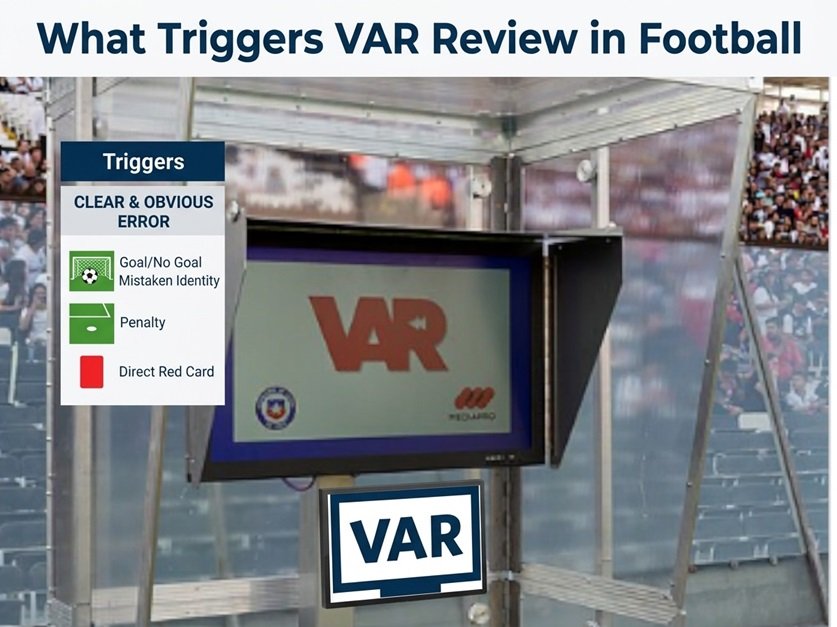
A possible clear and obvious error or serious missed incident in a reviewable, match-changing decision is what triggers VAR review in football. Goals, penalties, sending-off incidents and mistaken identity are the main areas; the current IFAB protocol also covers clearly incorrect second cautions and allows an optional, limited check on wrongly awarded corners. But an automatic check isn’t the same as a referee reviewing a decision.
That difference explains why an incident can be checked without the referee going near the monitor. It also explains why players demanding a review don’t get to decide whether one happens.
What does VAR actually do?
VAR stands for video assistant referee: a match official who watches footage and advises the referee about eligible incidents. The referee still makes the final decision, either using information from VAR or after watching replays at the pitchside monitor.
The referee must make an initial decision rather than leave everything to the video officials. Allowing play to continue counts as a decision, so a referee waving away a penalty appeal doesn’t prevent VAR from checking it.
If you want the wider introduction first, our guide to what VAR is and how it works explains the system beyond the review triggers.
Which incidents can trigger a VAR review?
Goals and offences in the build-up
VAR can check whether a goal should count. That includes an attacking handball, foul or offside in the build-up, whether the ball went out before the goal, and whether it entered the goal.
Some offences during a penalty kick are also reviewable. These include offences by the goalkeeper or kicker, and encroachment by a player who becomes directly involved after a rebound from the goalkeeper, post or crossbar.
So the review isn’t always about the final touch. Say a striker scores after a team-mate committed an attacking foul in the build-up: that earlier foul can be the reason for intervention.
Penalties given or not given
Both directions are covered. VAR can intervene when a penalty has been wrongly awarded or when a penalty offence has gone unpunished. It can also check whether the offence happened inside or outside the penalty area.
The attacking team’s actions before the incident matter too. An attacking foul, handball, offside or the ball going out of play before the penalty incident can form part of the check.
For example, the referee might correctly identify a foul but place it outside the box. If footage establishes that it happened inside, VAR can communicate that factual correction without requiring a monitor visit.
Sending-off incidents
Reviewable sending-off incidents include serious foul play, violent conduct, biting, spitting, offensive or abusive actions, and denying an obvious goalscoring opportunity. That last offence is often shortened to DOGSO.
A serious incident doesn’t have to be seen by the referee first. A missed act of violent conduct, for instance, can bring VAR into the decision.
The current IFAB protocol also includes a clearly incorrect second caution. That means a mistaken second yellow leading to a dismissal can be reviewed; it doesn’t make every yellow-card disagreement reviewable.
The referee cards the wrong player
VAR can help when the referee gives a yellow or red card to the wrong player from the offending team. This is called mistaken identity.
There’s a limit here. A mistaken-identity review corrects who receives the card, not automatically whether the underlying offence deserved punishment. The offence itself must qualify separately as a reviewable incident.
A wrongly awarded corner, where the competition allows it
The IFAB protocol gives competitions the option to use VAR for a clearly incorrectly awarded corner. The correction must happen immediately and without delaying the restart.
So don’t assume every competition using VAR also uses this option. And don’t treat it as permission for a lengthy review of every disputed corner: the protocol sets a specific, narrow condition.
A check isn’t the same as a review
VAR automatically checks situations within its remit. If the footage doesn’t reveal an error needing intervention, the check can finish without stopping the match. You may hear this described as a silent check.
A formal review is different. VAR can recommend it, but only the referee can initiate the review, and the referee retains the final decision.
| What happens | What it means |
|---|---|
| Automatic check | Video officials examine an eligible incident; no change or delay may be needed. |
| Factual information from VAR | The referee can correct a factual issue, such as the location of a foul, without watching the monitor. |
| On-field review | The referee watches replays, usually to assess a judgement call such as whether a challenge deserves a red card. |
That’s why “the referee didn’t go to the screen” doesn’t mean VAR ignored the incident. A check may have confirmed the original decision, or a factual correction may not have required an on-field review.
What does “clear and obvious” mean?
The original decision isn’t supposed to change simply because another interpretation is possible. Under IFAB’s protocol, the video must clearly show that the original decision was wrong. VAR can also assist with a serious incident the officials missed.
This matters most with judgement calls. Whether a challenge is a foul or warrants a red card may require the referee to assess the action, rather than merely establish where it happened. That’s why these decisions commonly involve the monitor.
Factual questions work differently. Offside position or whether an established foul occurred inside the area can generally be communicated directly to the referee.
From what we know, the useful distinction is between disagreeing with a decision and footage clearly demonstrating an error. The review threshold is built around the latter, not around how strongly either set of supporters feels.
What doesn’t trigger a review?
VAR isn’t a general appeal system for every whistle. A routine free-kick disagreement or an ordinary first-yellow-card dispute doesn’t become reviewable just because the footage is available. The incident must fit a permitted category, such as a penalty, goal-related offence or sending-off incident.
Context can change that. A foul outside the box may be reviewable if it involves a potential direct red card, while an attacking foul may be checked because it occurred in the build-up to a goal.
And players or coaches don’t have to request a check. The protocol says checks happen automatically, and players and team officials must not surround the referee or try to influence the review process.
Common questions while you’re watching
Does a monitor visit mean the decision will change?
No. The referee makes the final decision and can retain the original call after reviewing the footage. A recommendation to review isn’t an instruction to overturn.
Why do some checks take longer?
Some checks can finish silently, while others delay play as officials assess a possible mistake. IFAB sets no time limit for the review process because accuracy takes priority over speed.
What do the referee’s signals mean?
Pointing to the ear can indicate that a check is ongoing. Drawing a rectangle with the hands signals an on-field review; the referee repeats the television-screen signal before communicating the decision afterwards.
Can VAR intervene after play has restarted?
Generally, once play has stopped and restarted, the referee cannot go back for a review. Exceptions include mistaken identity and potential sending-off offences involving violent conduct, spitting, biting or extremely offensive, insulting or abusive actions.
Can a missed second yellow be treated like a wrong second yellow?
The current protocol specifically lists a clearly incorrect second caution. That isn’t a general power to revisit every challenge that supporters believe should have earned another yellow. A potential direct-red offence remains a separate reviewable matter.
Next time there’s an argument over VAR, start with one question, which reviewable category does the incident fit? If it doesn’t fit one, then, the existence of a replay alone isn’t enough to bring VAR into the decision.

Bernard Bassey
Bernard Bassey runs SPBO Scores from Abuja and writes about football rules, records and Nigerian football.