Handball in the Penalty Area: Rules, Penalties and Common Confusion
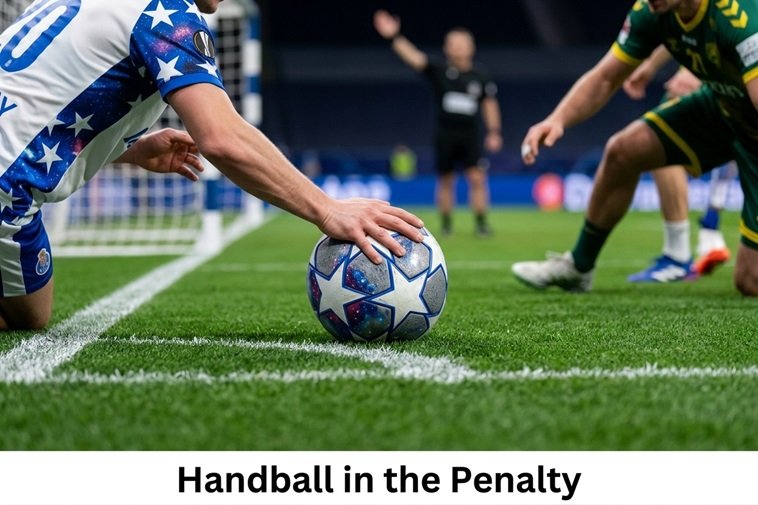
A ball hitting a defender’s hand inside their own penalty area does not automatically mean a penalty. The referee must decide whether the player deliberately handled it or made their body unnaturally bigger with their arm. Those are the main tests behind handball in penalty area rules.
So, before you shout “penalty!”, there’s another question: what was the player doing with that arm? Law 12 explicitly says that not every touch of the hand or arm is an offence.
When does handball become a penalty?
A handball offence by a defending outfield player inside their own penalty area results in a penalty. But the ball must be in play, and the contact must actually meet the definition of an offence. Simply being inside the box doesn’t make otherwise legal contact punishable.
For a defender, the two main grounds for a handball decision are:
- Deliberate handling: the player intentionally touches the ball with their hand or arm, such as moving it towards the ball.
- Making the body unnaturally bigger: the ball hits an arm whose position isn’t a consequence of, or justifiable by, the player’s movement in that situation.
That second point explains why “he didn’t mean it” doesn’t settle the argument. A player can commit handball without deliberately moving their arm towards the ball.
What does “unnaturally bigger” actually mean?
It means the player’s arm has increased the space their body blocks in a way their movement doesn’t justify. The referee has to consider the particular action, rather than judge every arm position in isolation.
Players use their arms while running and jumping. An arm moving away from the body can be part of a normal football movement; it isn’t automatically an offence just because there’s a gap between the arm and the player’s side.
But there’s a difference between using your arms to move and spreading them to create a bigger barrier. NISOA’s explanation gives the example of a player approaching an attacker with their arms stretched high and wide to block the ball. That position can make the body unnaturally bigger.
Say a defender stretches an arm sideways, without that position being justified by their movement, and a cross hits it. Even if they never move the arm towards the ball, that contact can be a handball offence.
Does accidental handball count?
Sometimes, yes. Accidental contact can still be penalised if the player’s arm has made their body unnaturally bigger. Equally, contact that is neither deliberate nor caused by an unjustifiable arm position isn’t automatically an offence.
This is why “ball to hand” isn’t a complete explanation. It describes how the contact happened, but doesn’t answer whether the arm position was legal.
| Situation | How the rule applies |
|---|---|
| A defender moves their hand towards the ball to stop it | That is deliberate handling and an offence. |
| A cross hits an outstretched arm in an unjustifiable position | It can be handball even without deliberate movement towards the ball. |
| The ball hits an arm held close to the body during normal movement | That contact is not automatically an offence. |
| An attacker accidentally handles the ball and immediately scores | The goal cannot stand. |
What if the ball comes from close range?
A close-range shot hitting a defender’s arm isn’t automatically a penalty. But “there was no time to react” isn’t a blanket exemption either: the arm’s position still matters under the unnaturally-bigger test.
The same care is needed when the ball changes direction before hitting an arm. Rather than treating every deflection as decisive, keep the central questions in mind: was the handling deliberate, and was the arm position justifiable for that movement? Those are the tests set out in Law 12.
What about a falling player’s supporting arm?
An arm used to support a falling player can be justified by that movement. Contact with that arm isn’t automatically handball.
But don’t treat “he was falling” as the end of the discussion. The referee still has to judge the actual arm position and whether it makes sense for that particular movement.
Where does the shoulder end and the arm begin?
For handball decisions, the upper boundary of the arm is level with the bottom of the armpit. The shoulder itself is outside that handball boundary.
So a ball striking the shoulder isn’t the same as one striking the upper arm below that line. You need to establish where the contact happened before debating whether the arm position was legal.
Why can accidental attacking handball rule out a goal?
The goalscorer has an additional restriction. A player cannot score directly with their hand or arm, even accidentally. They also cannot score immediately after the ball touches their own hand or arm, even if that touch was accidental.
Say a striker accidentally knocks the ball with their hand, then immediately kicks it into the goal. The goal is disallowed even if that first contact wasn’t deliberate and their arm wasn’t making their body unnaturally bigger.
But don’t stretch that rule into “any accidental touch by any attacker cancels the goal”. The specific automatic restriction concerns the player scoring directly with their hand or arm, or immediately after their own hand or arm contact. Other contact still needs to be assessed under the handball criteria.
Are goalkeepers treated differently?
Yes. A goalkeeper is exempt from the ordinary handball offence inside their own penalty area. Outside it, they face the same handling restrictions as other players.
However, that exemption doesn’t mean a goalkeeper can always pick the ball up inside the box. An indirect free kick, rather than a penalty, is awarded for certain prohibited handling offences, including:
- Handling a ball deliberately kicked to them by a team-mate, subject to the law’s exception where the goalkeeper has clearly kicked or attempted to kick it to release it into play.
- Handling the ball directly from a team-mate’s throw-in, subject to that same exception.
- Handling the ball again after releasing it, before another player has touched it.
That’s why a goalkeeper picking up a prohibited back-pass doesn’t produce the same restart as an outfield defender deliberately stopping a shot with their hand.
How should you judge a disputed handball?
In a nutshell, the most useful starting point isn’t “did it touch his hand?” It’s “why was his arm there?” That keeps the discussion focused on the distinction Law 12 makes between simple contact and an actual offence.
If the argument turns to a video review, our explanation of VAR in football covers that side of the decision. For the handball itself, remember this: being accidental doesn’t automatically make contact legal, and being inside the box doesn’t automatically make it a penalty.

Bernard Bassey
Bernard Bassey runs SPBO Scores from Abuja and writes about football rules, records and Nigerian football.