Offside Law Exceptions Explained: When Should the Flag Stay Down? (2026)
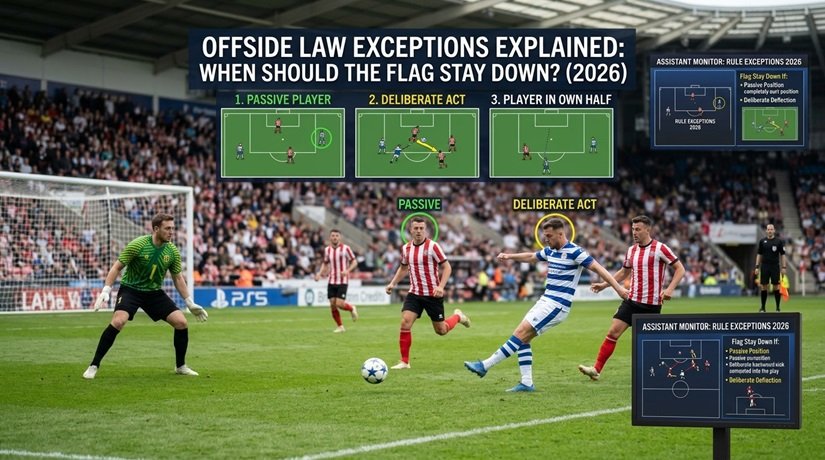
You can’t commit an offside offence by receiving the ball directly from a goal kick, throw-in or corner kick. Those are Law 11’s three explicit exceptions. Other situations, including receiving an opponent’s deliberate pass or starting a run from your own half, need a little more explanation.
The word directly matters. So does the difference between a defender playing the ball and the ball simply bouncing off them. Here’s offside law exceptions explained, with the distinctions that can settle an argument while you’re watching a match.
First, being in an offside position isn’t an offence
A player is in an offside position when part of their head, body or feet is in the opponents’ half and nearer the goal line than both the ball and the second-last opponent. Hands and arms don’t count. Neither does the halfway line count as part of the opponents’ half.
But position alone isn’t enough. The player must then become involved by playing the ball, interfering with an opponent or gaining an advantage from a rebound, deflection or save. Their position is assessed when a team-mate plays or touches the ball, not when they receive it.
That means an attacker can stand beyond the defensive line without being penalised, provided they don’t become involved in one of those ways. And a player level with the second-last opponent isn’t in an offside position.
If you want the basic positioning rules first, read our explanation of the offside rule in football.
The three direct-reception exceptions
Law 11 specifically says there’s no offside offence when a player receives the ball directly from these three restarts.
| Restart | Can the direct receiver be penalised for offside? | What happens after a team-mate touches it? |
|---|---|---|
| Goal kick | No, even if positioned beyond the second-last opponent. | Normal offside assessment applies to that new touch. |
| Throw-in | No, regardless of the receiver’s position relative to the defensive line. | Normal offside assessment applies to that new touch. |
| Corner kick | No, when receiving directly from the corner. | Normal offside assessment applies to that new touch. |
The protection covers direct reception, not every later pass or touch in the attack.
Goal kicks: the long ball can go beyond the defence
An attacker can receive a goal kick directly while standing nearer the opponents’ goal line than both the ball and the second-last opponent. Their position doesn’t create an offside offence from that direct delivery.
Say a striker waits beyond the defensive line and receives a long goal kick. That’s allowed. But if a team-mate heads the goal kick onwards, the striker’s position must be assessed at the header.
Don’t confuse a goal kick with every ball a goalkeeper kicks. A goalkeeper’s kick during open play doesn’t receive this exception.
Throw-ins: you can receive beyond the defensive line
A player can’t be penalised for offside when receiving directly from a throw-in. They don’t need to stay level with the second-last opponent for that reception.
Say a winger receives a throw-in beyond the defence and then passes to a striker. The winger’s reception is protected, but the striker’s position is assessed when the winger plays the pass.
Corners: the first delivery is protected
There’s no offside offence from receiving a corner kick directly. But the exception doesn’t carry through the entire corner routine.
If a player flicks the corner towards a team-mate, that touch creates a fresh offside assessment. The same applies when a short-corner receiver passes the ball back to the original taker.
Why your own half isn’t quite another exception
A player entirely in their own half cannot be in an offside position when a team-mate plays the ball. That’s part of the definition of offside position, rather than one of the three restart exceptions.
So a striker can start in their own half, run beyond the defenders and receive the ball in the opponents’ half. What matters is where the striker was when the team-mate played it.
But running back doesn’t erase an earlier offside position. A player who was offside when the pass was played can return to their own half and still commit an offence by playing that ball. The resulting indirect free kick can therefore be awarded in their own half.
A defender’s deliberate play can change the decision
This is where a simple shout of “the defender touched it” isn’t enough. An attacker receiving the ball from an opponent who deliberately played it isn’t considered to have gained an advantage from their earlier offside position, unless that play was a deliberate save.
For this purpose, deliberate play means the opponent had control with the possibility of passing, gaining possession or clearing the ball. An inaccurate pass or failed clearance can still count. The attempt doesn’t have to succeed.
Law 11 gives several indicators for judging that control:
- The ball travelled from a distance and the player could see it clearly.
- It wasn’t moving quickly or arriving from an unexpected direction.
- The player had time to coordinate their movement.
- The contact wasn’t merely an instinctive stretch or jump with limited control.
- A ball travelling along the ground is easier to play than one in the air.
Say a defender sees a slow pass coming, has time to set themselves and tries to clear it, but sends it to an attacker. That can be deliberate play despite the poor clearance. A fast ball merely clipping an outstretched boot is a different situation.
And this doesn’t cancel an offence already committed. If the attacker has already challenged the defender for the ball from an offside position, that involvement can itself be penalised.
Deflections, rebounds and saves don’t clear offside
A deflection isn’t the same as deliberate play. A player who was offside when a team-mate played the ball can still be penalised after it rebounds or deflects off an opponent, a goalpost, the crossbar or a match official.
The same applies after a deliberate save. In Law 11, a save means stopping or attempting to stop a ball heading into, or very close to, the goal. It isn’t limited to goalkeepers; an outfield player can make a save too.
Say a striker is offside when a team-mate shoots. The goalkeeper saves, and the striker scores from the rebound. The save hasn’t removed the offside offence.
The useful distinction is control, not contact. A defender deliberately playing a ball can change the offside assessment. A ricochet or save does not offer the same protection.
Other questions that cause arguments
Can you be offside from a free kick?
Yes. Free kicks aren’t among the three direct-reception exceptions. A player in an offside position when a team-mate takes the kick can be penalised if they become involved in active play.
Can you be offside from a goalkeeper’s throw?
Yes. A goalkeeper’s throw isn’t a throw-in. Normal offside rules apply, and the position is assessed at the goalkeeper’s last point of contact when releasing the ball. For other plays or touches, the first point of contact is used.
Does a backwards pass always mean no offside?
No. The direction of the pass isn’t the legal test. The receiver’s position relative to the ball and second-last opponent is what matters when the team-mate plays it. A player level with or behind the ball isn’t in an offside position.
That’s why a square pass to a team-mate behind the ball can be legal even when both attackers are beyond the second-last opponent. Don’t judge the situation only by counting defenders.
Can you be penalised without touching the ball?
Yes. An offside attacker can interfere by clearly blocking an opponent’s view, challenging for the ball or attempting to play a nearby ball in a way that affects an opponent. An obvious action that clearly affects an opponent’s ability to play the ball can also qualify.
So leaving the ball alone isn’t always enough. Standing in an offside position and clearly blocking the goalkeeper’s view of a shot can still lead to an offence.
Does a foul on an offside player count?
The order matters. If the player is fouled before playing or attempting to play the ball, or challenging an opponent, the foul is penalised first. If their offside involvement has already happened before the foul challenge, the offside offence takes priority.
The word to remember is “directly”
For goal kicks, throw-ins and corners, ask whether the attacker received the restart directly or after a team-mate’s touch. For a ball coming off a defender, ask whether it was deliberate play, a deflection or a save. Those distinctions explain why two attacks that look almost identical can produce different offside decisions.
Sources

Bernard Bassey
Bernard Bassey runs SPBO Scores from Abuja and writes about football rules, records and Nigerian football.