AG vs FG Football Boots: Differences and Which to Choose
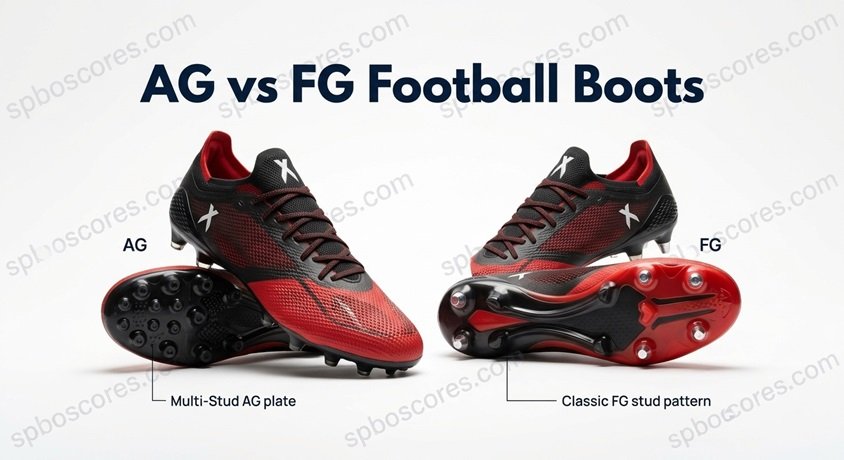
AG boots are designed for artificial grass, while FG boots are mainly for firm natural grass. The main AG vs FG football boots differences are underneath: AG soles usually have shorter, more numerous studs, while FG soles use moulded studs designed to grip natural ground. So the better choice starts with your pitch, not the boot’s appearance.
But there’s a catch. Rounded studs don’t automatically make an FG boot suitable for artificial grass, and not every synthetic pitch needs the same footwear. Here’s how to choose without confusing grip, comfort and surface suitability.
AG vs FG boots at a glance
AG means artificial grass; FG means firm ground. These labels describe the intended playing surface, rather than a player’s position or style of football.
| What you’re comparing | AG boots | FG boots |
|---|---|---|
| Best surface | Modern artificial grass, including 3G. | Firm natural grass that is dry or slightly damp. |
| Typical studs | Shorter studs with more contact points across the sole. | Moulded studs, with rounded, bladed or mixed layouts. |
| Pressure underfoot | More contact points help spread the load on artificial grass. | Longer studs can cause uncomfortable pressure when the ground is too hard to penetrate. |
| Turning | Designed around artificial grass; rounded layouts help the foot rotate and release. | Behaviour varies: rounded studs generally release more easily than aggressive blades. |
| Main limitation | Not a universal answer for every artificial surface; shorter, harder astro may suit TF footwear. | An FG label alone does not establish suitability for artificial grass. |
What actually changes underneath the boot?
Stud length and number
The soleplate is the base underneath your boot that carries the studs. Dedicated AG plates normally use shorter studs and more points of contact, spreading pressure across the foot rather than concentrating it through fewer, longer studs.
FG studs are designed to find grip in natural soil. They’re suitable for firm grass, but can become uncomfortable on very hard ground because they cannot sink in properly.
This is why “more grip” isn’t a useful buying rule on its own. In our view, the better question is whether the studs can work properly on the surface you actually play on.
Stud shape and release
Stud shape affects more than straight-line traction. Rounded, or conical, studs generally allow easier rotation, while blades can provide stronger directional bite. Their positioning also affects how the boot grips and releases during turns.
But FG isn’t one fixed design. Pro: Direct points to the F50, Mercurial, Predator and Tiempo as examples of boots whose FG soleplates can differ, using rounded shapes, directional studs or a mixture.
So don’t assume two FG boots will behave alike simply because they carry the same letters. And don’t assume a rounded FG sole is an AG sole in disguise.
Which gives better grip and comfort?
On firm natural grass, FG is the starting point. Its studs are designed to grip soil on dry, firm or slightly damp pitches without needing the deeper penetration of soft-ground footwear.
On modern artificial grass, dedicated AG is the recommended option. Its shorter studs and greater number of contact points are designed to provide traction for accelerating, stopping and changing direction on synthetic turf.
Comfort follows the same surface-specific logic. An FG plate on ground that’s too hard can concentrate pressure beneath the studs, while AG’s extra contact points help distribute the load on artificial grass. That doesn’t make AG universally more comfortable; it explains why matching the sole to the pitch matters.
If rubbing is your main problem, you can also read our guide to stopping football boots from blistering your feet. Treat that as a separate concern from choosing the correct ground type.
Can you wear FG boots on artificial grass?
You’ll see players doing it, but that isn’t the same as every FG boot being suitable. Pro:Direct recommends dedicated AG footwear for artificial grass wherever possible, with the manufacturer’s approval determining whether a particular FG model is appropriate.
If you’re choosing between FG designs, rounded studs are generally less aggressive on artificial grass than longer, heavily bladed layouts. They tend to let the foot rotate and release more naturally. But that remains a compromise, not a replacement for an AG plate.
There are three separate issues here:
- How the studs interact with the pitch: longer FG studs can catch on artificial surfaces.
- Whether the boot is approved: rounded studs alone don’t establish manufacturer approval for artificial grass.
- Whether the venue permits them: facilities can have their own footwear rules.
Using a boot outside its approved surfaces may also affect warranty cover. Meanwhile, choosing dedicated AG or an approved multi-ground option is more sensible than assuming a preferred FG design will be fine.
What if your pitch is hard, muddy or older astro?
Sometimes neither AG nor FG is the best match. The important distinction is the actual surface, not simply whether you’re playing outdoors.
Hard, dry natural ground
A very hard natural pitch isn’t automatically an FG pitch. Pro: Direct identifies HG, or hard-ground boots, as footwear designed for dry, compacted natural surfaces, using shorter, widely spread studs. Longer FG studs may struggle to penetrate that ground comfortably.
Wet, muddy natural grass
Slightly damp grass can still suit FG. Genuinely soft, muddy ground is different: FG studs may grip only the loose upper layer rather than reach firmer soil underneath. Soft-ground, or SG, boots use longer studs, often metal, for those conditions.
Short, hard artificial turf
AG and TF aren’t interchangeable labels. TF means turf footwear and typically uses small rubber lugs for older, shorter or harder artificial surfaces. AG is the recommended starting point for modern 3G grass.
So if you call every synthetic surface “astro”, pause before buying. That word alone doesn’t settle whether you need AG or TF.
Which should you buy for your usual football?
- Mostly firm natural grass: FG is the best starting point for dry or slightly damp conditions.
- Regular football on modern artificial grass: choose dedicated AG rather than treating FG as the default.
- A mix of natural and artificial grass: an approved MG, or multi-ground, boot may suit you. MG covers selected surfaces, not every pitch.
- Older, shorter artificial turf: TF is the more appropriate category to consider.
- Very hard or muddy natural ground: consider HG or SG respectively rather than forcing an AG-versus-FG choice.
Our view is straightforward: let the pitch decide the soleplate, then choose the boot you like within that category. A venue allowing your footwear and a manufacturer approving it are separate matters, don’t mistake one for the other.

Bernard Bassey
Bernard Bassey runs SPBO Scores from Abuja and writes about football rules, records and Nigerian football.