What Is a Clean Sheet in Football? Meaning, Stats & Examples Explained
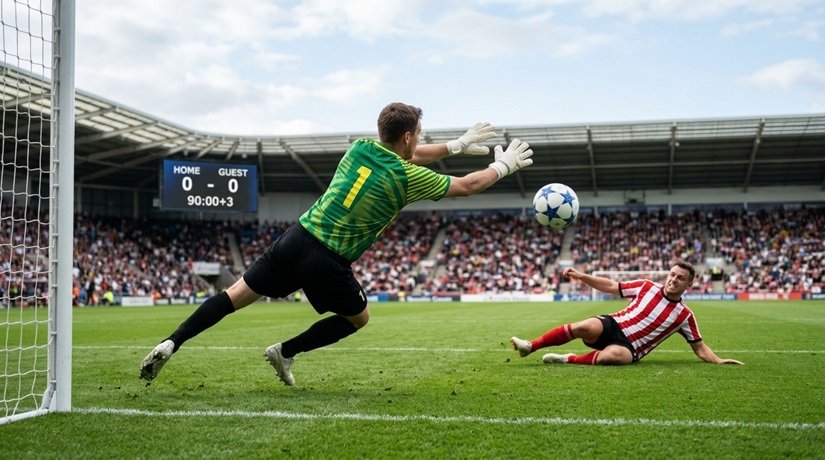
A clean sheet in football means a team finishes a match without conceding a goal. You don’t have to win to keep one: a 0-0 draw gives both teams a clean sheet. But once your team concedes, even in the final moments, its clean sheet is gone.
That’s the simple answer to “what is a clean sheet in football?” The useful distinction is between keeping a clean sheet and winning a match. One describes your defending; the other describes the result.
Which scorelines count as a clean sheet?
Look at how many goals a team conceded, not how many it scored. A team that wins 1- 0 has kept a clean sheet. A team that wins 4 – 1 hasn’t, despite scoring more goals and winning comfortably.
These hypothetical scorelines show how it works. In each case, Team A’s score appears first.
| Final score | Team A clean sheet? | Team B clean sheet? |
|---|---|---|
| 0–0 | Yes | Yes |
| 1–0 | Yes | No |
| 3–0 | Yes | No |
| 1–1 | No | No |
| 0–2 | No | Yes |
So, scoring plenty of goals doesn’t make a result a clean sheet. The deciding number is zero goals conceded.
Does a clean sheet mean your team won?
No. A clean sheet can come in a win or a draw. If neither side scores, both have successfully kept the opposition out, but neither has won.
That’s why “we kept a clean sheet” and “we won” aren’t interchangeable. A 0-0 draw can show defensive strength while leaving a team without the goal it needed to win.
But keeping opponents out gives a team a useful foundation. Once you prevent them from scoring, a single goal of your own is enough to win.
Who gets the credit: the goalkeeper or the whole team?
Goalkeepers receive much of the attention, but a clean sheet is a team achievement. Defenders stop attacks, midfielders intercept passes and support the back line, and attackers can help by pressing and tracking back.
The goalkeeper still has several jobs. Saving shots is one, but communicating with defenders and controlling the penalty area also help a team keep opponents out.
Think of the defensive work as a chain:
- Attackers can put opponents under pressure and help defend set pieces.
- Midfielders can break up attacks before they reach the defence.
- Defenders need to mark opponents, hold their positions and move together.
- The goalkeeper saves shots and helps organise the players ahead.
In our view, it’s better to treat a clean sheet as shared credit rather than proof that one player did everything. That fits the different defensive jobs involved.
What can end a clean sheet?
A late goal still counts
Keeping the opposition out for most of a match isn’t enough. A goal conceded in the 90th minute ends the clean sheet, and stoppage time counts too. The team must protect that zero through the end of normal time and its added minutes.
An own goal counts against your team
An own goal also ends a clean sheet. It doesn’t matter that an opposition player didn’t score it: your team has still conceded a goal.
A big win doesn’t cancel out a goal conceded
Say your team leads 4-0 and then concedes once. It can still finish with a comfortable victory, but it cannot finish with a clean sheet. Winning margin and clean sheets measure different things.
Why do managers care so much about clean sheets?
Clean sheets reduce what a team needs from its attack to win. They also reflect defensive organisation, with players carrying out their roles and limiting opponents’ chances.
José Mourinho’s Chelsea side in the 2004–05 Premier League season is a useful real example. Chelsea kept 25 clean sheets and conceded only 15 goals across 38 league matches. They finished with 95 points, 12 ahead of runners-up Arsenal.
Those numbers describe two related achievements. The 25 clean sheets tell you how often Chelsea shut opponents out completely. The 15 goals conceded tell you how few goals they allowed across the whole league season.
But a clean sheet doesn’t explain everything about a performance. The opposition’s attacking strength, missed chances and luck can all affect whether a team concedes.
In our view, it’s more useful to ask how a team earned its clean sheet than to assume every goalless defensive record tells the same story. An organised display and a match full of opposition misses can produce the same zero.
How do teams try to keep a clean sheet?
There isn’t just one approach. A team might defend deep in a low block, keeping its defensive shape close to its own goal. Another might play more aggressively while maintaining cover behind its attacks. The opposition’s style helps shape that choice.
Set-piece organisation matters too. At corners and free-kicks, players need clear responsibilities: who they are marking, which spaces they are protecting and where they should stand.
And concentration has to last. Good positioning, communication and tracking opponents all help, but a lapse can allow the goal that ends the clean sheet.
Why do player statistics sometimes look different?
A team’s clean sheet and an individual player’s clean-sheet statistic aren’t always recorded in the same way. Sportmonks, for example, credits a player who leaves the pitch without conceding even if the team later lets in a goal.
Its example is a defender substituted at 0–0 whose team subsequently concedes. Under that system, the player can retain a clean sheet in their individual statistics, although the team doesn’t finish with one.
Fantasy football adds its own conditions. Sportmonks notes that Fantasy Premier League requires a goalkeeper to play at least 60 minutes to qualify for clean-sheet points. That’s a scoring condition, not the basic definition of a team’s clean sheet.
Why is it called a clean sheet?
Jobs in Football traces the expression to the days when sports reporters recorded goals on paper. If no goals were recorded against a team, that part of the sheet remained blank, or “clean”.
The easiest way to remember it is still the simplest: check the goals conceded. If that number stays at zero, the team has kept a clean sheet, whether it scored plenty itself or none at all.

Bernard Bassey
Bernard Bassey runs SPBO Scores from Abuja and writes about football rules, records and Nigerian football.