How to Prepare for a Football Trial: Fitness, Skills and Match-Day Readiness
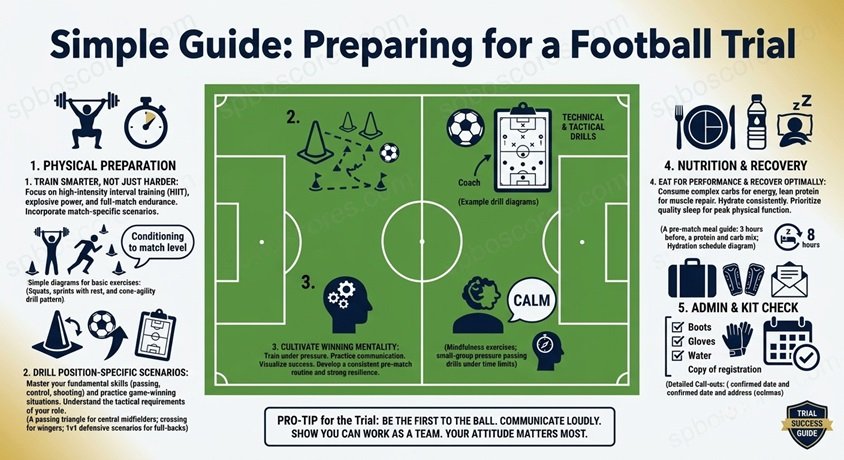
To prepare for a football trial, keep your training consistent, practise your skills under pressure and arrive ready to listen and play your role. Don’t try to squeeze months of work into the final few days. Your decisions, teamwork and response to coaching matter alongside what you can do with the ball.
If you’re wondering how to prepare for a football trial, start with this: prepare to play useful football, not just to produce one spectacular moment. SIA Academy, for example, says it values game understanding, adaptability and commitment alongside technical ability.
What is a football trial?
A football trial is an assessment where players have an opportunity to show how they play and learn. But an academy invitation, a grassroots team assessment and an independent showcase aren’t the same experience. Understand which opportunity you’re attending before building expectations around it.
The format and assessment priorities can vary. Technical exercises, small-sided games and game situations may be used to assess skills and decisions, so ask the organiser what to expect. No training programme or paid event can guarantee selection.
Confirm the arrangements before you travel
Preparation starts before you touch a ball. Confirm the organiser, venue, date, contact person and nature of the opportunity through an official channel. If someone claims to represent a club, contact that club using independently obtained details rather than relying only on the invitation message.
For a young player, a parent or carer should be involved. Ask about supervision, collection arrangements, consent and medical information, as well as any permissions connected to your current registration.
Get these practical details clear early:
- The arrival time and expected timetable.
- The playing surface and required equipment.
- The expected activities or assessment format.
- Who to contact if you’re injured, unwell or delayed.
- Any registration permissions or paperwork you need.
Don’t assume that arrangements from a previous trial apply to this one. Follow the current organiser’s instructions.
Build fitness without arriving exhausted
Football preparation includes endurance, strength, speed and coordination. SIA Academy recommends working on these areas at least three to four weeks before its assessment, while also managing training load and rest. That’s preparation over time, not a last-minute fitness challenge.
FCV International Football Academy suggests strength exercises such as squats, lunges and push-ups, alongside speed and agility work such as cone sprints and shuttle runs. These are possible training tools, not a reason to suddenly add every exercise to your existing programme.
Keep your workload consistent with what you’re already doing, and discuss changes with your coach. Hard sessions immediately before a trial may leave you tired rather than better prepared.
Warm up before training, allow for recovery, eat a balanced diet and stay hydrated. If you’re injured or unwell, tell the club and ask how to proceed instead of hiding the problem.
Practise skills you can use in a game
Ball control, passing, shooting and dribbling all deserve attention. FCV recommends exercises such as wall-passing and dribbling through cones, including work with both feet.
But clean technique without pressure is only part of the preparation. SIA describes trial assessments in which players must execute skills against opposition and make quick decisions. Small-sided games give you a way to practise those demands together.
Connect your technique to a decision
Don’t make every practice about completing a trick or hitting a powerful shot. Work on choosing an appropriate pass, staying available to teammates and responding when possession changes. Those behaviours keep your contribution connected to the game.
Say you’re a winger with space to attack a defender, but a teammate has a better passing option. Taking the opponent on isn’t automatically the strongest trial performance; the useful decision depends on the situation and the coach’s instructions.
In our view, the most helpful balance is individual ball work alongside competitive practice. One lets you focus on execution; the other asks you to use that skill while reading the game.
Understand your role, including when you don’t have the ball
Tactical awareness means understanding what’s happening and choosing how to respond. Coaches may assess your positioning, support for teammates and reaction to transitions—the moments when possession changes hands.
Study players in your position, but watch more than their highlights. Pay attention to their decisions and movement, including how they offer support and respond to the opposition. FCV recommends watching matches with a focus on decision-making and position-specific skills.
Before a trial, think about a few useful behaviours rather than a target you can’t fully control. Listening to the task, communicating relevant information and recovering your position are more controllable than deciding you must score three goals.
If a coach asks you to play an unfamiliar position, briefly clarify your main responsibility. You don’t need to pretend you’ve played there for years. Show that you’re willing to understand the job.
Show that you can listen and adapt
A trial isn’t only about displaying what you already know. Coaches may also be interested in how you learn, although their priorities vary. Listen to explanations, ask a short question if something is unclear and try to apply an adjustment in the next suitable moment.
SIA Academy identifies respect, communication and willingness to learn among the qualities it values. Asking for the ball, encouraging a teammate and responding to tactical changes are all relevant parts of participation.
You don’t have to turn every action into a performance for the coach. Keep your communication useful and your attention on the task. That fits the emphasis on relevant information and following instructions.
Handle nerves and mistakes without chasing the game
A trial can make an ordinary mistake feel much bigger than it is. After a poor touch or misplaced pass, recover your position and support the next action. Trying to make up for it immediately with an unrealistic decision can pull you away from useful football.
FCV suggests mental preparation such as visualising successful actions and setting achievable goals. Keep those goals focused on behaviours you can influence, rather than an outcome like selection.
For example, you could aim to listen carefully to each task and respond constructively to feedback. Avoid loading yourself with several new technical instructions just before arrival.
Parents can help by staying calm on the touchline and respecting the venue’s rules. Competing instructions can make an unfamiliar setting harder for a young player to manage.
What should you bring to a football trial?
Follow the organiser’s kit instructions first. Use familiar footwear suited to the stated surface, and sort out your equipment, travel and food arrangements ahead of time.
FCV’s suggested trial checklist includes:
- Football boots.
- Shin pads.
- Training kit.
- A water bottle.
- A notepad and pen for useful notes.
For related kit guidance, see how to stop football boots from blistering your feet and the rules for football shin guards.
Arrive on time and greet coaches and other players respectfully. Punctuality and a professional attitude are part of preparation, not something to consider only after the football starts.
Common questions before a trial
How long should you prepare?
There’s no single preparation period that fits every player or event. SIA recommends at least three to four weeks of specific physical preparation, but your existing programme matters. Don’t suddenly increase your workload because an invitation has arrived.
Do you need to score to stand out?
Scoring depends partly on the chances you receive. An appropriate pass, recovering your position or helping a teammate can also matter, even if the action doesn’t look spectacular. Keep your intentions suited to your role and the coach’s instructions.
What if you make a mistake?
Stay involved. Recover your position, support the next phase and avoid forcing a difficult action simply to compensate. The aim isn’t to pretend the mistake didn’t happen; it’s to preserve your ability to contribute afterwards.
Does paying for an event guarantee selection?
No. A paid event cannot guarantee selection. Clarify what the opportunity actually involves before committing to it.
Before you leave, ask what happens next
Find out how and when the club intends to communicate its decision. Don’t assume you’ll receive an immediate answer or a detailed individual report. If feedback is offered, look for one useful development priority.
And assess the environment yourself. Were instructions clear? Did you feel safe and respected? Do you understand the commitments if an offer follows? A trial is also your chance to learn about the place you may join.
If you’re not selected, don’t invent an explanation the club hasn’t given. Use any feedback to choose your next training focus. One assessment is part of your development, not a complete verdict on your future.

Bernard Bassey
Bernard Bassey runs SPBO Scores from Abuja and writes about football rules, records and Nigerian football.