What Is the Offside Rule in Football? Explained
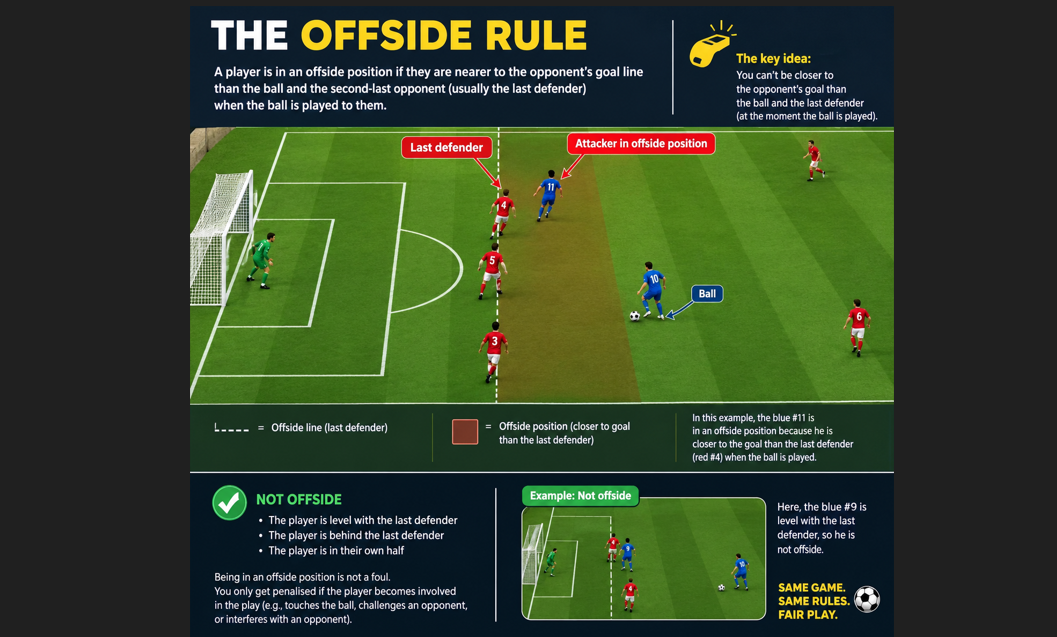
What is the offside rule in football? A player is in an offside position when their head, body or feet are in the opponents’ half and nearer the goal line than both the ball and the second-last opponent. But it becomes an offence only if they get involved in active play after a team-mate plays or touches the ball.
That difference explains why a striker can stand beyond the defence without being penalised, while another player can commit an offside offence without touching the ball. Position matters, but so do timing and involvement.
What counts as an offside position?
Under Law 11, both of these conditions must apply at the relevant team-mate’s touch:
- Some part of the player’s head, body or feet is in the opponents’ half, excluding the halfway line.
- Some part of their head, body or feet is nearer the opponents’ goal line than both the ball and the second-last opponent.
Hands and arms do not count, for attackers or defenders, including goalkeepers. The boundary between the arm and the rest of the body is level with the bottom of the armpit. So an outstretched hand cannot put a striker offside. A head, foot or part of the body beyond the relevant line can.
Why the second-last opponent, not the last defender?
The goalkeeper is usually the opponent nearest the goal line, but not always. The law counts opponents by their position, not by whether they are a goalkeeper, defender or midfielder.
If the goalkeeper comes forward, do not automatically use the deepest outfield defender as the offside reference. You still need to identify the second-last opponent.
Level is onside
A player level with the second-last opponent, or the last two opponents, is not in an offside position. And a player behind or level with the ball is not in an offside position, even if they are beyond those opponents. Say two attackers are beyond the defence and one passes across goal. If the receiver is behind or level with the ball when it is played, they are not offside.
When is offside judged?
Judge the position when the team-mate plays or touches the ball, not when the receiver collects it. Normally, the relevant instant is the first point of contact. For a goalkeeper’s throw, it is the last point of contact instead. Let say a striker is onside when a midfielder passes, then sprints beyond the defence to receive it. That run does not make the striker offside: they were onside at the relevant touch.
The reverse also matters. A player who was in an offside position cannot avoid the offence simply by running back into an onside position before receiving that same pass. When watching a replay, look at the passer’s contact before judging the receiver’s position. An image taken when the ball arrives can tell a very different story.
When does the position become an offence?
Standing in an offside position is not enough. The player must become involved by playing the ball, interfering with an opponent or gaining an advantage from a rebound, deflection or save.
Playing or touching the ball
A player who was in an offside position at the relevant team-mate’s touch commits an offence by playing or touching that ball. A header, shot or controlling touch can all qualify.
Interfering without touching the ball
An attacker can also be penalised without making contact with the ball. Law 11 covers these actions:
- Clearly blocking an opponent’s view in a way that prevents them from playing or being able to play the ball.
- Challenging an opponent for the ball.
- Clearly attempting to play a nearby ball when that action affects an opponent.
- Making an obvious action that clearly affects an opponent’s ability to play the ball.
For instance, an attacker in an offside position could obstruct the goalkeeper’s view of a team-mate’s shot and prevent the goalkeeper from playing it. The attacker need not touch the shot to commit an offence. But simply standing near the goalkeeper is not enough by itself. The player’s involvement must meet the rules and regulations conditions.
Do rebounds and saves make an attacker onside?
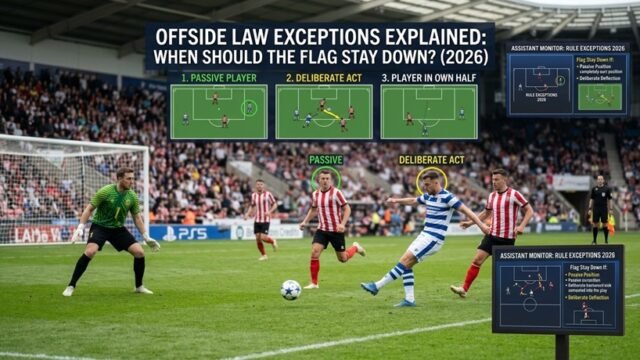
No. A rebound or deflection does not automatically remove an earlier offside position. A player can be penalised for playing the ball or interfering with an opponent after it comes off a post, the crossbar or an opponent. The same applies after a deliberate save.
Say a striker is in an offside position when a team-mate shoots. The goalkeeper saves, and the striker taps in the loose ball. That is an offside offence; the save does not make the striker’s involvement legal.
A save means stopping, or trying to stop, a ball going into or very close to the goal. It can be made by an outfield opponent too, although the definition excludes hands and arms except for the goalkeeper inside their penalty area.
What if a defender deliberately plays the ball?
This is different from a deflection. An attacker receiving the ball from an opponent’s deliberate play is not considered to have gained an advantage from their earlier offside position, unless that play was a deliberate save.
Under Law 11, deliberate play involves control with the possibility of passing, gaining possession or clearing the ball. A misplaced pass or unsuccessful clearance can still count: a poor result does not automatically make it a deflection.
To assess control, the law considers factors such as the opponent’s view of the ball, its speed and direction, and the time available to coordinate their movement. An instinctive stretch or jump with limited contact or control is different from having time to play the ball.
So a defender touching the ball does not settle the argument. The nature of that touch matters, especially whether it was deliberate play, a deflection or a save.
When does offside not apply?
There is no offside offence when a player receives the ball directly from any of these restarts:
- Through a goal kick.
- A throw-in.
- Or the corner kick.
The word directly matters. If another team-mate then plays or touches the ball, the receiver’s position is assessed at that new touch under the normal offside conditions. Free kicks are not among the three exceptions.
Common offside questions
Can you be offside in your own half?
You cannot be in an offside position if your head, body and feet are entirely in your own half or on the halfway line. But you can be penalised after returning there from an offside position to play a team-mate’s pass. The indirect free kick can therefore be awarded in your own half.
Does a backwards pass always mean no offside?
Not automatically. The law tests the receiver’s position against the ball and the second-last opponent at the team-mate’s touch, rather than simply the direction of the pass. A receiver who is level with or behind the ball is not in an offside position.
What happens if the attacker is fouled?
The order of events matters. If a player in an offside position is fouled before playing or attempting to play the ball, or challenging an opponent, the foul is penalised first. If the offside offence has already occurred before the foul challenge, offside takes priority.
What is the punishment for offside?
The defending team receives an indirect free kick where the offence occurred, rather than necessarily where the attacker stood when the pass was made. An ordinary offside offence is not itself a foul or misconduct.
The assistant referee signals with a raised flag, but the referee makes the final decision. A goal following an offside offence cannot stand simply because play continued before the whistle.
What to watch during the next attack
Watch the team-mate’s touch, compare the attacker with both the ball and the second-last opponent, then follow their involvement. If the ball comes off a defender, consider what kind of contact occurred. Those distinctions explain why two attacks that look similar can produce different decisions.
And when a striker is standing alone near goal, do not judge from that image alone. They may have timed the run correctly – or they may not have become involved at all.

Bernard Bassey
Bernard Bassey runs SPBO Scores from Abuja and writes about football rules, records and Nigerian football.

2 comments