The Role of an Inverted Winger in Football Game
The role of an inverted winger is to move infield from a wide attacking position to create chances, combine with teammates or shoot. Usually, that means a left-footed player on the right wing or a right-footed player on the left, bringing their stronger foot towards goal. But there’s more to the job than cutting inside and hoping to score.
Arjen Robben shows the shooting side of the role, while Neymar offers an example of its creative side. Both help explain why an inverted winger can be a scorer, a provider, or a mixture of the two.
What makes a winger inverted?
Think about which way the player’s stronger foot takes them. A traditional winger generally has that foot towards the touchline, helping them attack the outside and cross. An inverted winger has it towards the middle, making an inward movement a natural route to a shot, pass or dribble towards goal.
So, a left-footed right winger isn’t necessarily playing on the wrong side. The position can be a deliberate way to bring their best foot into more central attacking areas.
There’s also a narrower tactical meaning. The Mastermind Site describes inverted wingers as wide creators who receive in inside channels, rather than simply players who dribble in from the touchline. Under that definition, where they receive the ball and how they create chances matter more than the cutting movement alone.
That distinction helps explain why two players can both be called inverted wingers but look quite different during a match. One attacks goal with the ball; another receives further inside and looks for the pass into the penalty area.
How the role works during an attack
Moving into the half-space
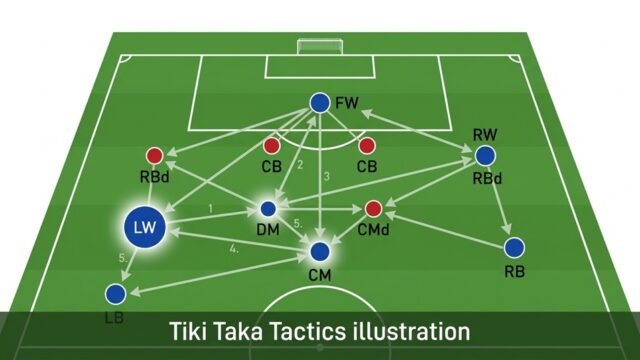
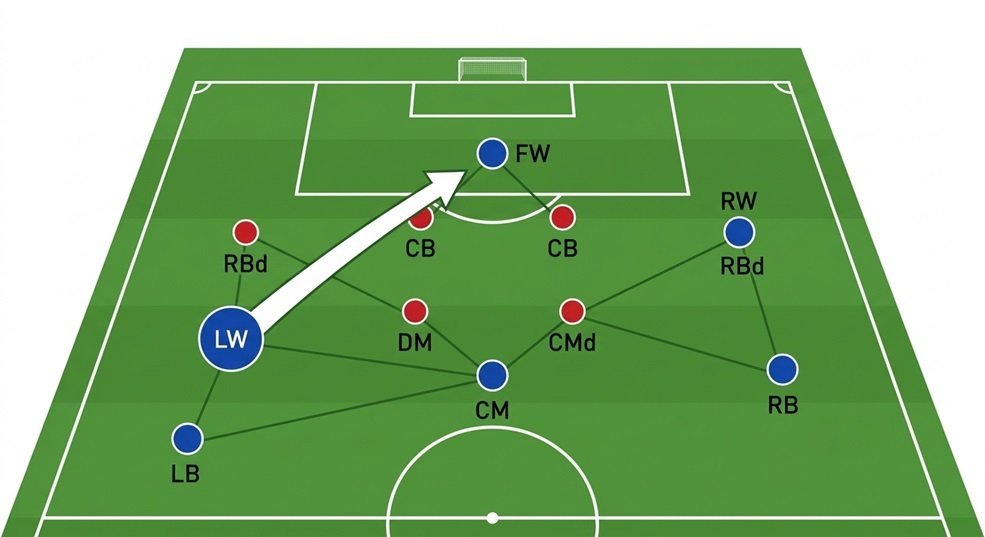
The half-space is the channel between the wing and the centre of the pitch. An inverted winger can move into this area with the ball or position themselves there to receive it. From there, they have options to pass, dribble or shoot.
The important point is that the player doesn’t always need to beat someone first. Receiving in an inside channel and finding a teammate with an incisive pass can be just as central to the job.
Choosing between a shot and a pass
Cutting onto the stronger foot creates a decision for the defender. Giving the winger space can allow a shot or through ball. Moving closer can leave an opportunity for the attacker to go outside instead.
But cutting inside shouldn’t become an automatic response. The winger still needs to read the defender and choose between shooting, passing to a teammate or carrying the ball forward. Decision-making under pressure is part of the role, not an optional extra.
Opening the outside lane
When the winger moves infield, the full-back can advance into the space outside them. This is an overlap: a supporting run around the outside of the player with the ball. The movement can create a two-against-one situation against the opposing full-back.
Now the defender has more than the winger to consider. The attacker can use the overlapping teammate or continue towards goal, depending on the defender’s response. The partnership works through coordinated movement, not just individual dribbling.
Traditional winger vs inverted winger
The difference is mainly about direction and attacking priorities. Neither approach is automatically better in every situation.
| Feature | Traditional winger | Inverted winger |
|---|---|---|
| Stronger foot | Usually towards the touchline | Usually towards the centre |
| Typical movement | Attacks down the outside | Moves into an inside channel |
| Main attacking options | Beat the defender and cross | Shoot, combine or play a through ball |
| Relationship with width | Stays wide to threaten the flank | Can leave the outside lane for a full-back |
These are broad tendencies, not a rule that limits either player to one action. Inverted wingers can still attack outside, and their final decision should respond to the space and pressure around them.
Robben, Neymar and Salah show different versions
Robben: the threat of the shot
Arjen Robben is a clear example of the goal-threatening version. His left-footed dribbling and curling shot became a trademark of his inverted-winger play. Moving towards goal put his stronger foot in position to finish attacks.
That’s the version many fans picture first: a wide attacker coming inside and looking to shoot. But it doesn’t cover everything the role can involve.
Neymar: creating from inside channels
The Mastermind Site uses Neymar to explain a more creative interpretation. Its assessment emphasises his tendency to receive in the half-spaces and provide chances, while recognising his dribbling and goalscoring ability.
In that version, the winger can work like a number 10, the creative player operating behind the attack. The difference is that the inverted winger receives more often in wide and inside-wide channels rather than primarily central areas.
Salah: why the categories overlap
Mohamed Salah shows why these labels aren’t neat boxes. The Mastermind Site describes him as combining chance creation, goalscoring and one-against-one dribbling. It also highlights his inward movement while Henderson or Alexander-Arnold overlap, alongside his ability to stay wide and take opponents on.
In our view, it’s more useful to ask what a winger is doing in a particular attack than to argue over one permanent label. Salah’s example shows how the same player can provide width, move inside and threaten goal.
What does the team need around them?
An inverted winger’s movement affects the rest of the attack. The full-back partnership is especially important because an overlap can give the team an outside option when the winger moves infield.
Without that support, the attack can become too narrow and crossing opportunities can fall. JugglePro also highlights the difficulty of using inverted wingers against a compact defence when full-backs cannot advance beyond them.
There is a defensive trade-off too. The flank can become exposed if the full-back cannot get forward or recover after advancing. The attacking benefit therefore comes with a need for balance.
Nor does the role belong to one formation. The Mastermind Site identifies systems such as 4-2-2-2, 3-4-2-1 and 4-3-2-1 as natural settings for inside positioning, while noting that inverted wingers can appear in other systems.
Common questions about inverted wingers
Do they have to score lots of goals?
No. Some interpretations prioritise chance creation over finishing. An inverted winger can make their main contribution through passes into the penalty area, even if they also carry a scoring threat.
Do they always start beside the touchline?
No. Some begin wide and cut inside with the ball. Others already occupy an inside channel when they receive it. Both patterns help explain how the term is used.
Is an inverted winger the same as a number 10?
Not quite. Their creative work can overlap, but an inverted winger starts from a wide role and receives more often in wider channels. A creative number 10 operates more centrally and may drop deeper to help move the ball forward.
What should you watch during a match?
Watch the full-back as well as the winger. When the attacker moves inside, does a teammate offer a run outside? That movement can explain why the winger has room to shoot or a passing option beyond the defender.
And don’t judge the move only by whether the winger shoots. A pass into the penalty area or an opening created for the overlapping full-back can be the purpose of moving inside in the first place.

Bernard Bassey
Bernard Bassey runs SPBO Scores from Abuja and writes about football rules, records and Nigerian football.