Tiki Taka Tactics Explained: How Passing Becomes Control
Tiki-taka is a football style built on short, quick passes, intelligent movement and keeping possession to create openings. The aim isn’t simply to collect passes: it’s to move opponents out of position, then attack the space they leave.
Barcelona under Pep Guardiola and Spain’s title-winning national team made the approach famous. But why can one passing move pull a defence apart while another goes nowhere? The difference is often what happens away from the ball.
What makes tiki-taka different from ordinary possession football?
Possession football is the broader idea of controlling a match through the ball. Tiki-taka is a more specific version, with tightly rehearsed combinations, short passing options and players comfortable receiving in crowded areas.
A team can keep the ball without doing all of that. Tiki-taka combines possession with coordinated movement, positional discipline and pressure immediately after losing it.
So, don’t judge it by the passing alone. The important question is whether those passes are making the opposition move and opening a route towards goal.
How does tiki-taka work?
Short passes keep the ball moving
Players commonly use one or two touches, moving the ball quickly between nearby teammates. Good close control and quick decisions help them keep possession even when opponents are pressing. Patience matters too. Rather than forcing a difficult final ball, the team can circulate possession until a better opening appears. The intention is to make the defence keep adjusting until someone leaves a gap. That doesn’t mean a forward pass is forbidden. Short combinations are the method; breaking through the opposition is still the purpose.
Triangles give the player on the ball options
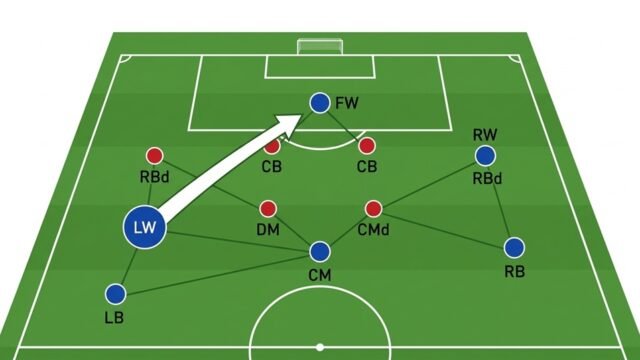
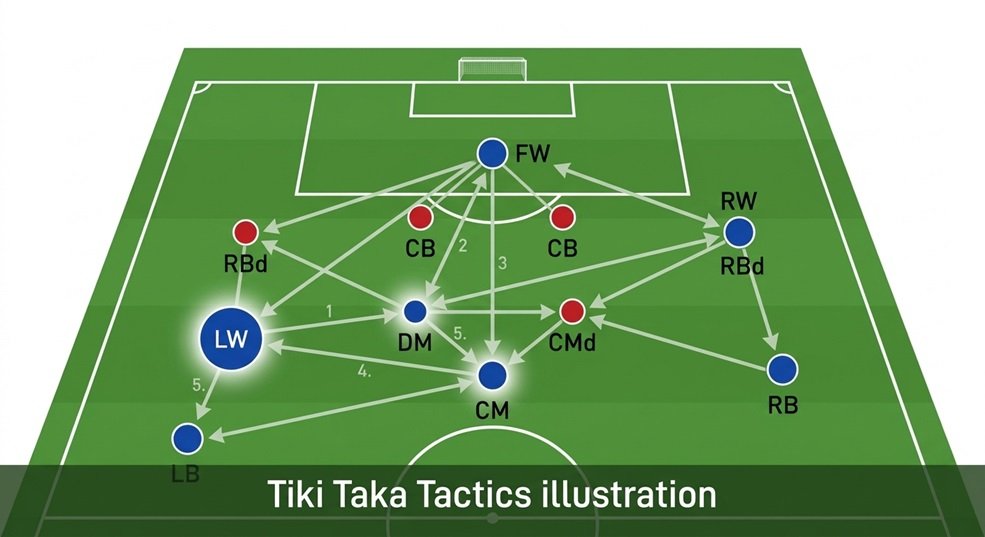
A passing triangle forms when three teammates position themselves at useful angles to one another. Ideally, the player with the ball has two nearby passing options rather than one predictable route.
Say a midfielder receives under pressure. A teammate behind and another diagonally ahead can give them a safe return pass and a possible way forward. That’s a simple example of the support tiki-taka tries to create.
Teams also create overloads, meaning they put more players than the opposition in a particular area. That extra player can help them combine around pressure and progress up the pitch.
The movement continues after the pass
Passing and then standing still would remove much of the system’s threat. Players move again to offer support, take a marker away or create room for someone else.
But movement isn’t the same as everybody chasing the ball. Positional play means maintaining useful spacing and understanding when to move, when to hold a position and when to exchange roles.
Close support doesn’t mean ignoring the wings
Tiki-taka uses close combinations and often narrow groups of players around the ball. Yet Guardiola’s Barcelona also used high full-backs and wider attacking spacing to make the pitch bigger in possession.
Those ideas can work together: nearby teammates help the ball-carrier escape pressure, while players further out stretch the opposition. The team needs useful distances, not everyone crowded into the same patch of grass.
What happens when the team loses the ball?
This is the part you can easily miss while admiring the passing. A tiki-taka team usually presses immediately after a turnover, trying to recover possession before the opponent can organise an attack.
That immediate attempt to win it back is called counter-pressing. It connects the attacking and defensive sides of the system: the team wants to recover the ball quickly and start controlling play again.
There is a risk, with players pushed forward and the defensive line high, an opponent who escapes the press can attack the space behind them.
So tiki-taka isn’t just a technique for gifted midfielders. The team’s reaction without the ball is part of what makes the passing game possible.
Which formation and player roles suit tiki-taka?
The classic shape is a 4-3-3: a deep midfielder, two midfielders further forward and a front three, with full-backs supporting attacks. A 3-4-3 can also work; the formation alone doesn’t define the style.
| Role | What the player contributes |
|---|---|
| Goalkeeper and defenders | Accurate passing and calm control to help build possession from the back. |
| Deep-lying playmaker | A passing option at the base of midfield in the classic 4-3-3 structure. |
| Advanced midfielders | Support ahead of the deep midfielder, with the technique to keep the ball under pressure. |
| Full-backs | Support for attacks, with Guardiola’s Barcelona pushing them higher up the pitch. |
| Centre-forward or false nine | Close combinations up front, or movement into midfield to create an extra passing option. |
A false nine is a central forward who drops into deeper positions rather than staying alongside the opposition centre-backs. That movement can add another player in midfield and draw a defender forward, leaving space for wide forwards.
But a false nine isn’t compulsory. A more traditional centre-forward can fit if they have the touch and passing ability to combine in tight spaces.
Barcelona and Spain; the real examples
Guardiola’s Barcelona
Tiki-taka’s roots include Dutch Total Football and the possession ideas Johan Cruyff introduced at Barcelona. The approach developed through the club and its La Masia academy before Guardiola’s spell as manager from 2008 to 2012. Guardiola’s Barcelona combined midfield control, positional changes and intense pressure on the ball. He won 14 titles during that spell.
The details went beyond short passes. Barcelona built from the goalkeeper, pushed full-backs forward and used a false nine to create different passing angles. Players developed through La Masia, including Xavi, Andrés Iniesta and Lionel Messi, brought the touch and vision needed for that approach.
Spain’s three consecutive major titles
Spain won Euro 2008, the 2010 World Cup and Euro 2012 using tiki-taka under Luis Aragonés and Vicente del Bosque. Aragonés led the Euro 2008 victory; Del Bosque led the next two title wins.
These teams show that tiki-taka wasn’t only a club-football idea. Spain also used possession and technical midfield play to control matches at international level.
Why does tiki-taka work-and where can it fail?
Its main strength is control. Keeping the ball limits the opposition’s opportunities to attack, while repeated passing makes defenders shift and chase. Good movement can then turn that control into an opening.
But possession isn’t a goal. Against opponents defending well in their own half, patient passing can become a long spell of circulation without a meaningful threat.
The main trade-offs are easy to recognise:
- Control versus penetration: keeping the ball helps, but the team still needs passes and movement that threaten goal.
- Close support versus counter-attacking space: the high, narrow shape can become vulnerable when the immediate press fails.
- Ambition versus technical demands: receiving under pressure requires strong control, accurate passing and quick decisions throughout the team.
Defending deep and staying organised can make it harder for tiki-taka teams to create chances. Escaping their counter-press offers another route, because it exposes the space behind their advanced players.
Common questions about tiki-taka
Is tiki-taka just sideways passing?
No, sideways and backward passes can help retain possession, but the intended outcome is to shift opponents and find an opening. Without that threat, the team is keeping the ball without achieving the attacking purpose.
Is tiki-taka the same as Total Football?
No, SPBO helped lay its foundations through positional interchange, technical play and pressing. Tiki-taka developed those ideas with a particular emphasis on passing combinations and sustained possession.
Can tiki-taka use longer passes?
Yes, short passing is the preference, not an absolute ban on distance. Longer passes can be used when the route is open.
Has tiki-taka disappeared?
Its pure form is less prominent, but positional play, pressing and possession remain influential. Modern approaches have combined those elements with more direct attacks and quicker transitions.
In conclusion, the most useful thing to watch is the next movement, not just the next pass. When a player releases the ball, look at who offers support, who stretches the defence and who moves towards the opening. That’s where the passing starts to make sense.

Bernard Bassey
Bernard Bassey runs SPBO Scores from Abuja and writes about football rules, records and Nigerian football.