Best Goalkeeper Glove Latex for Wet Weather: Aqua vs Contact and More
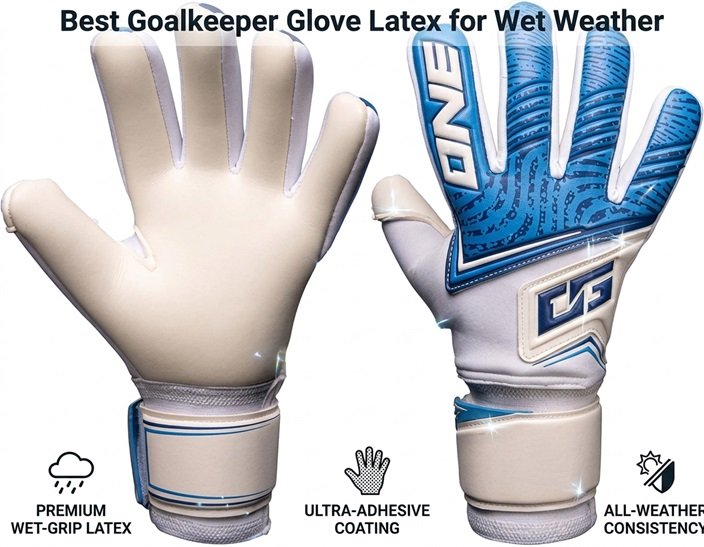
Our pick for the best goalkeeper glove latex for wet weather is a dedicated Aqua compound, such as One Glove’s Cyclone, if rain is your main concern. Cyclone is formulated for wet conditions, while the brand’s Contact latex is described as excellent in the dry and capable in rain when excess water is removed.
But that doesn’t make Aqua the automatic choice for every goalkeeper. In our view, the useful comparison is between a wet-weather specialist and a palm that suits your mix of training and matches. Here’s how those options compare, including Supergrip+, Gold X and URG 2.0.
Which latex suits your football?
One Glove describes Cyclone as its wet-weather specialist, Contact as its pro-grade option with strong dry grip, and Giga as a balance of grip, durability and value. Those are different priorities, not simply three rungs on the same ladder.
The table separates those manufacturer descriptions from Unisport’s ratings of specific glove models. A score for one glove shouldn’t be treated as a universal score for every glove using that latex.
| Latex | Wet-weather evidence | Dry-weather evidence | Our best-for verdict |
|---|---|---|---|
| Aqua: One Glove Cyclone | Designed to excel in wet conditions. | Performs well if kept damp. | A dedicated rainy-match pair. |
| One Glove Contact | Described as performing well in rain with excess water towelled off. | Described as excellent in dry conditions. | Mixed conditions, especially with plenty of dry football. |
| Uhlsport Supergrip+ | Unisport rates the Powerline Supergrip+ HN at 9/10 for wet grip. | The same glove receives 9/10 for dry grip. | A balanced alternative on that retailer’s assessment. |
| Reusch Gold X | Unisport gives the Attrakt Gold X 9/10 for wet grip. | The same glove receives 9.5/10 for dry grip. | Dry grip remains a major priority. |
| adidas URG 2.0 | Unisport gives the Predator Pro Hybrid 8.5/10 for wet grip. | The same glove receives 9/10 for dry grip. | A mixed-weather shortlist rather than our wet-first pick. |
| One Glove Giga | The brand’s description emphasises overall balance rather than wet-weather specialisation. | Positioned around grip, durability and value. | General use where value and wear matter alongside grip. |
Aqua vs Contact
Aqua is our choice for a rain-focused pair
Cyclone needs a pre-wash to activate, and One Glove says you should still remove excess water from its palms. It also needs to stay damp when used in dry conditions.
That care requirement matters. You’re choosing a specialist palm, not a glove you can soak and forget about. One Glove specifically warns that Aqua latex doesn’t remove the problem of a layer of water sitting between your palm and the ball.
In our view, Cyclone makes the clearest sense if you’re buying a separate pair mainly for wet matches. Its stated purpose matches that job directly, without relying on a general all-weather claim.
Contact deserves more credit than “dry-weather only”
One Glove says its Pro Grade Contact latex performs well in rain, provided you towel off excess liquid. The brand also describes its dry-weather grip as excellent.
So we wouldn’t dismiss Contact just because rain is possible. If most of your football is dry and you want one pair, it’s a reasonable compromise based on that description.
There’s a useful distinction here: wet-capable isn’t the same as wet-specialist. Contact has a stated role in both conditions; Cyclone is specifically formulated for tricky wet conditions. Your choice should reflect which job matters more to you.
How do Supergrip+, Gold X and URG 2.0 compare?
Unisport’s ratings put the Uhlsport Powerline Supergrip+ HN and Reusch Attrakt Gold X level on wet grip at 9/10. Gold X has the higher dry score in that comparison: 9.5/10 against 9/10.
On those figures alone, we’d shortlist Supergrip+ for an evenly balanced wet-and-dry option, and Gold X if dry grip still carries extra weight. Neither rating establishes how either compound compares directly with Cyclone.
URG 2.0 also shows why the glove model matters. Unisport rates the adidas Predator Pro Hybrid at 8.5/10 for wet grip, but the Predator Pro at 8/10, despite listing URG 2.0 for both. Both receive 9/10 for dry grip.
Don’t read too much into a small score difference. Our view is that these ratings help build a shortlist, but they don’t justify declaring one latex an outright winner across every glove design.
Is ACC another kind of latex?
Not in the same sense. Unisport describes Nike’s ACC, short for All Conditions Control, as a treatment applied to the palm surface rather than a replacement for the underlying latex compound.
Its comparison ranks the Nike Phantom Elite first, with 9.5/10 for wet grip and 8.5/10 for dry grip, and lists ACC as its wet-weather technology.
That makes it relevant if you’re choosing a complete glove. But for a latex comparison, keep the categories separate: Aqua describes a wet-weather compound, while ACC describes a surface treatment. We wouldn’t call ACC the winning “latex”.
Where does durability fit?
One Glove positions Giga around a balance of grip, durability and value. Its Origin latex is aimed at beginners and recreational use, with durability and shot-stopping as its stated priorities.
Neither description makes those palms our first recommendation for a dedicated wet-match pair. But if you’re buying for regular practice rather than rain-specific performance, that balance deserves consideration.
Care and playing surface also affect latex durability, according to One Glove. So we wouldn’t promise a lifespan or claim that one of these compounds will last a particular number of matches.
Our verdict: choose the job before the name
- Mostly buying for rain? We’d choose a dedicated Aqua option such as Cyclone.
- One pair, with plenty of dry football? We’d lean towards Contact rather than automatically choosing a wet specialist.
- Comparing complete gloves? Supergrip+ and Gold X deserve a shortlist based on Unisport’s wet-and-dry ratings.
- Prioritising value and regular use? Giga’s stated balance is more relevant than chasing a wet-grip score alone.
And keep a towel available. Even One Glove’s wet-weather specialist requires excess water to be removed; the Aqua name doesn’t mean leaving the palms waterlogged.

Bernard Bassey
Bernard Bassey runs SPBO Scores from Abuja and writes about football rules, records and Nigerian football.