Rest Defense in Football Explained: Shapes, Roles and Examples
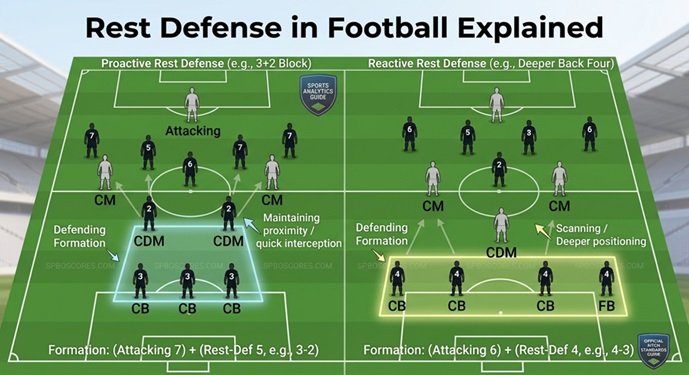
Rest defence is the structure a team keeps behind and around the ball while attacking, ready to stop a counter-attack if possession is lost. It’s defending before you actually need to defend.
Those players aren’t simply waiting for their teammates to score. They support possession, cover dangerous spaces and prepare to win the ball back or slow the opposition down. To understand the idea, look beyond the player crossing or shooting: who is protecting the team if that move breaks down?
What does “rest defence” mean?
The term comes from the German Restverteidigung, with “rest” referring to what remains rather than taking a break. In football, it describes the players left around or underneath the attack and their defensive responsibilities.
That distinction matters. Rest defence isn’t passive: players must adjust their positions, watch opponents and anticipate where the next dangerous pass could go.
Coaches’ Voice describes a common balance of five players attacking and five outfield players forming the rest defence. A more aggressive approach might commit six to attack and leave four providing protection. So there’s no single number that every team must use.
How does it work during an attack?
The work begins while the team still has the ball. Players behind the attack need distances that let them support possession without leaving easy routes for an opposing counter-attack.
It’s a balancing act. Spread too far apart and they can struggle to block forward passes; bunch too closely together and they can restrict their own team’s attacking play.
Support the ball without abandoning cover
The deeper players offer passing options and help move possession across the pitch. They can also help keep opponents trapped in their defensive third, the area nearest their own goal.
But support doesn’t mean everyone follows the ball. Players must also cover spaces teammates have left, particularly when full-backs or midfielders push forward.
React when possession is lost
The first option is to regain possession through a tackle, interception, individual duel or recovery of a loose ball. Good anticipation and communication help players arrive where the danger is developing.
If an immediate regain isn’t possible, the next job is to delay the counter-attack and prevent quick forward progress. That buys time for attacking teammates to recover.
This is why stopping a counter doesn’t always require winning a tackle. Blocking a forward passing route and making the opponent slow down can give the rest of the team time to get back.
What do 3-2 and 2-3 mean?
Rest defence commonly has two lines, arranged as a 3-2 or 2-3. These numbers describe the deeper supporting structure, not the team’s entire formation.
| Shape | Deeper line | Higher line |
|---|---|---|
| 3-2 | Three players | Two players |
| 2-3 | Two players | Three players |
Both arrangements divide responsibility between players closer to a possible turnover and those protecting the space farther back.
The higher line stops the counter early
The higher line closes spaces around the ball, challenges opponents and tries to prevent the counter-attack from getting started. Defensive midfielders commonly do this work, although defenders can step into that line too.
You may hear this called “locking the edge” when it happens around the opposition penalty area. These players are positioned to contest clearances and loose balls, or delay an opponent who escapes with possession.
The deeper line protects against the escape pass
The deeper line deals with longer passes that bypass the first group. Its players may need to win aerial duels, challenge a forward holding up the ball or defend the space behind them.
A goalkeeper who comes out to cover space behind the defence can provide extra support. That matters because rest-defence units often operate around the halfway line.
Manchester City and Liverpool show the idea
Guardiola’s Manchester City
Coaches’ Voice highlights Pep Guardiola’s use of a 3-2 structure behind Manchester City’s five-player attacking line. João Cancelo and Oleksandr Zinchenko moved infield from full-back, while later versions involved John Stones or Manuel Akanji stepping forward from centre-back.
That movement explains why a player’s starting position doesn’t tell you everything. A full-back moving inside can help form the protective structure rather than staying near the touchline.
Klopp’s Liverpool
Total Football Analysis describes a Liverpool arrangement under Jürgen Klopp in which two midfielders stayed behind the ball while the left-sided full-back advanced. Their positions helped Liverpool begin counter-pressing as soon as possession was lost in the final third.
Here, the protection behind the attack supported the pressing approach. The midfielders were already positioned to react, rather than having to recover from farther forward.
Rest defence and counter-pressing aren’t the same thing
Rest defence is the preparation; counter-pressing is the immediate attempt to regain the ball after losing it. A well-organised rest defence puts players in positions from which they can counter-press effectively.
But counter-pressing isn’t the only response. The same structure must also help the team delay an attack or recover into a defensive block when an immediate regain isn’t possible.
So don’t judge it only by whether someone wins possession straight away. Slowing the opponent enough for teammates to return is another useful outcome.
Why can rest defence still go wrong?
A shape alone doesn’t remove the risk. Players need suitable spacing, awareness of opponents, communication and the ability to win individual contests.
- Gaps between players: poor compactness can leave forward passing routes open.
- Uncovered positions: teammates need to protect areas vacated by players joining the attack.
- Space behind the defence: a higher defensive line leaves a greater distance to cover towards its own goal.
- Poor anticipation: players must read likely passes and opposing movements, not just react after the danger develops.
Teams can adjust to the opposition by keeping a full-back deeper or holding both central midfielders behind the ball against a dangerous counter-attacking threat.
Common questions about rest defence
Is it just parking the bus?
No. Rest defence organises protection while a team attacks; it doesn’t mean giving up attacking ambition. The same players can support possession and prepare to stop counters.
Is it only the centre-backs’ job?
No. Midfielders and full-backs can form part of the structure, and some teams move a midfielder into the deeper line. Responsibilities depend on how the team arranges its attack.
Must you always leave an extra defender?
Coaches’ Voice describes a common “plus-one” approach: keeping one more covering player than the opponents have attackers. But the overall structure can change with the team’s appetite for risk and need for a goal.
Finally, the most useful question while watching is simple, if possession disappears now, who can stop the first forward pass? It shifts your attention from how many players are behind the ball to whether their positions actually offer protection.

Bernard Bassey
Bernard Bassey runs SPBO Scores from Abuja and writes about football rules, records and Nigerian football.