Best Football Training Drills for Beginners: 6 Options Compared
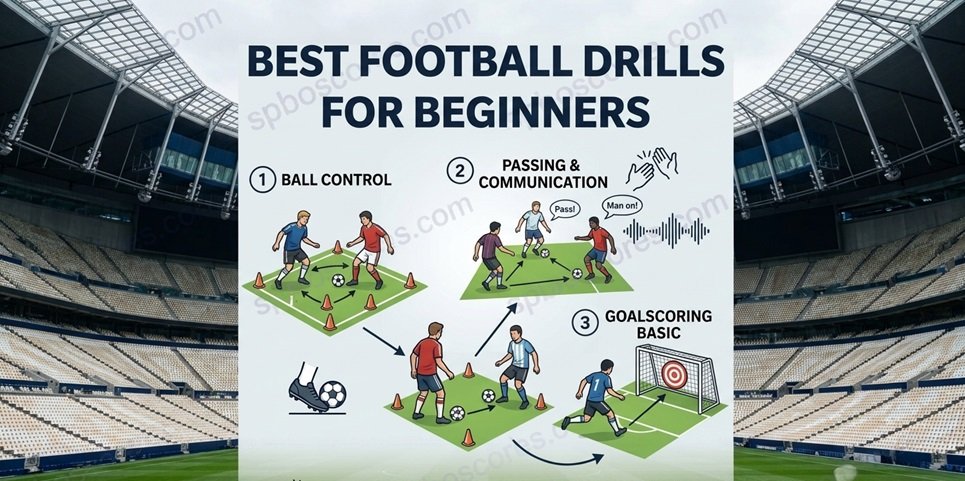
Our picks for the best football training drills for beginners are the dribbling square for close control, wall passing for passing and receiving, and target shooting for finishing. If you have other players available, we’d add wide-area one-on-ones and a small rondo to practise decisions against opposition. These exercises cover different skills, so the best choice depends on what you need to work on.
You don’t have to choose the most complicated drill. In our view, a useful starting point is an exercise you can understand, repeat and adjust without losing sight of its purpose. Below, we compare six options by equipment, player numbers, coaching focus and their main limitation.
Which beginner football drill should you choose?
The table separates individual technique work from exercises involving a defender. this coaching guidance makes a useful distinction: repeating a movement develops technique, while realistic pressure asks players to make decisions too.
| Drill | Players and equipment | Main focus | Our best-for verdict |
|---|---|---|---|
| Dribbling square | One player or a small group; one ball each and four cones. | Close control, both feet and looking up. | Best starting point for getting comfortable with the ball. |
| Wall passing and receiving | One player, a ball and a wall. | Passing accuracy, timing and receiving with different parts of the foot. | Best solo option for passing and first touch. |
| Turning to play forward | One player, one ball and four cones. | Receiving and turning towards the next action. | Best for making your first touch more purposeful. |
| Target shooting | One player, a ball and targets within a goal. | Shooting accuracy and technique with both feet. | Best for focused finishing practice. |
| Wide-area 1v1 | Two players, one ball, cones marking a channel and a small goal. | Reading a defender and choosing where to attack. | Best for learning to beat an opponent. |
| 3v1+1 rondo | Five players, one ball and cones marking a small grid. | Passing quality and movement after releasing the ball. | Best group option for possession decisions. |
Dribbling square: best for basic ball control
Four cones form a square, with each player working with their own ball. This is an eight-minute exercise for under-eights and older, suitable for an individual or a small group. Its emphasis is repeated ball work under low pressure.
The detail to watch is your head position. Look up between touches rather than watching the ball throughout. Use both feet and include touches with the outside of the foot; relying on one foot is a common mistake highlighted in the drill.
Compared with a one-on-one, the square gives you less opposition pressure. In our view, that’s its appeal for a complete beginner: you can concentrate on controlling the ball before worrying about beating somebody.
But don’t mistake comfortable cone work for success against a defender. We’d use the square as a starting exercise, then introduce an opponent when the aim changes from controlling the ball to choosing a route past someone.
Wall passing: best for practising alone
Pass against a wall and control the returning ball, concentrating on accuracy and timing. The International Football Academy recommends using both feet and practising receiving with the inside, outside and sole of the foot.
This gives you a different task from dribbling. Instead of keeping the ball close throughout, you’re sending it away and preparing for its return. Both passing and receiving are central to the exercise.
Our preference would be to make the receiving touch just as important as the pass. Ask yourself: did that touch leave the ball ready for the next action? That’s a more useful focus than treating every rebound as something to hit immediately.
Wall work is our strongest solo passing pick, but it isn’t a substitute for a teammate’s movement. For a group exercise that adds support and opposition, the rondo below is the better comparison.
Turning to play forward: best for a purposeful first touch
This individual exercise uses one ball and four cones. We’ve lists it for under-tens and older, with a suggested duration of 10 minutes. The focus is the transition between receiving the ball and turning to face forward.
The main mistake is stopping the ball completely before starting the turn. This guide explains that this slows the action and gives defenders time to close down. Its receiving cue is to use the foot furthest from the direction you want to play next.
Compared with general wall passing, this drill has a narrower purpose. You’re not simply controlling a return; you’re preparing to change direction and play forward.
In our view, it’s a useful next choice if you can stop a ball comfortably but often need another touch to organise yourself. Keep the question simple: is your receiving touch helping the next movement, or delaying it?
Target shooting: best for finishing practice
Place targets within a goal, using cones or selected areas to aim at. Practise shooting with both feet, keeping the emphasis on precision and technique. That’s the approach recommended by the International Football Academy.
Unlike the square or wall passing, this drill gives each attempt a clear destination. You can judge whether the shot went towards the area you intended rather than being satisfied that it merely reached the goal.
We’d choose it over general ball-control work when finishing is the specific priority. But we’d keep accuracy at the centre of the exercise, rather than turning every attempt into a contest to hit the ball harder.
The limitation is the absence of a live defender in this solo setup. In our view, target practice is useful for concentrating on the strike itself, while a one-on-one adds the earlier decision about how to create an opening.
Wide-area 1v1: best for beating a defender
This drill puts an attacker against a defender in a marked channel, with a small goal to attack. We’ve lists it for under-11s and older and suggests 15 minutes. The attacking focus is reading the defender before choosing a side.
The first touch matters. A touch into space can encourage the defender to commit, while a shorter touch can leave them hesitant. and also identifies running straight at the defender as a common mistake; the aim is to make the defender turn before attacking the space behind.
That’s the main difference from cone dribbling. A cone marks a route, but the defender gives you a decision to read. For learning how to respond to an opponent, we’d choose the live duel.
It’s also a useful partner exercise if you’re interested in wide attacking roles. For more context on one of those positions, read the role of an inverted winger in football.
3v1+1 rondo: best for passing with a group
A rondo is a keep-ball exercise with players trying to retain possession against a defender. This version uses three possession players plus a neutral player against one defender: five players altogether. We’ve lists it for under-11s and older, with a suggested duration of 12 minutes.
The neutral player supports the team keeping the ball. With that numerical advantage, we recommends focusing on the quality of passes rather than simply counting them. Another common mistake is standing still after passing, instead of moving to help make the next pass possible.
Compared with wall work, the rondo adds choices about whom to pass to and where to move afterwards. Compared with a one-on-one, its emphasis is keeping possession through support rather than beating the defender yourself.
Meanwhile, it’s the strongest group choice here once beginners can pass and receive with some control. Don’t judge it only by how long the ball stays away from the defender. Watch whether players help the next receiver.
How we’d choose your starting drill
If you’re training alone, we’d start with the exercise that matches your immediate difficulty: the square for close control, the wall for passing and receiving, or targets for finishing. Add turning practice when you want the first touch to prepare a change of direction.
With one partner, we’d favour the wide-area duel when the priority is responding to a defender. With five players, we’d choose the rondo for passing and support. Those exercises introduce opposition in different ways rather than making one universally better than the other.
In conclusion, the broader coaching principle is that a good drill teaches a particular skill, suits the players and includes meaningful decisions. Hence, before starting, agree on one thing to watch: looking up, receiving towards the next action, choosing a side or moving after a pass. In our view, that clear purpose matters more than squeezing every drill into one session.

Nshabum Divine
Divine Nshabum is a football news writer and contributor at SPBO Scores, where she covers the latest developments in football. Her work focuses on breaking news, transfer updates, club developments, player stories, and major football events from around the world. She is committed to delivering timely, accurate, and engaging football news that keeps readers informed about the beautiful game.