Box Midfield vs Diamond Midfield: Shapes, Strengths and Best Uses
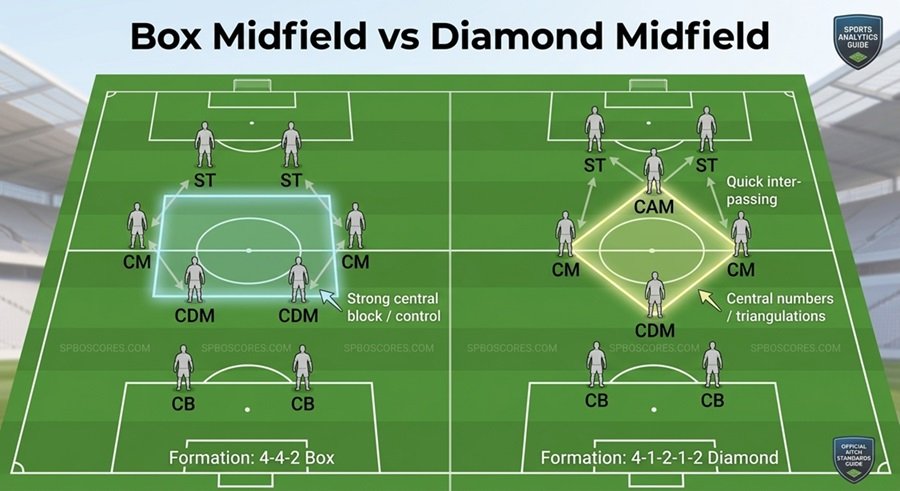
The main difference in box midfield vs diamond midfield is how the four midfielders line up. A box has two deeper players and two attacking midfielders; a diamond has one holding midfielder, two central midfielders and one attacking midfielder. Both concentrate players centrally, but they offer different passing options and responsibilities.
Neither shape wins simply because it looks better on a tactics board. In our view, the useful question is whether your team needs two players sharing the deeper work or has the right players for a single-pivot diamond. Manchester City’s use of John Stones alongside Rodri offers a clear example of the first approach.
What do the two shapes actually look like?
The box: two behind, two ahead
A box midfield has two pivots at its base and two number 10s higher up. A pivot is a deeper midfielder who supports possession and protects the defence; a number 10 operates further forward, often between the opposition’s midfield and defensive lines.
The deeper pair receive from the defenders and look for passes into the attacking midfielders or towards wide runners. The two 10s then create chances, combine with forwards, make runs behind the defence and contribute goals.
Those four players don’t have to begin the match as four central midfielders. A full-back can move inside to become the second pivot, or wide attackers can narrow into the two attacking positions.
The diamond: one behind, two between, one ahead
In the 3-4-3 diamond discussed by Tactics Journal, one holding midfielder sits behind two central midfielders, with a central attacking midfielder at the top. The two central midfielders occupy the half-spaces: the inside channels between the middle and the wings.
Compared with the box, those two central midfielders sit slightly deeper, while the attacking midfielder provides a central option ahead. Crucially, the holding player must be capable of operating without a second pivot alongside them.
These are midfield arrangements, not complete team formations. Coaches’ Voice describes boxes within both 4-2-2-2 and 3-4-3 structures, while Tactics Journal examines a diamond within a 3-4-3. The surrounding players matter too.
Box midfield vs diamond midfield at a glance
| Comparison | Box midfield | Diamond midfield |
|---|---|---|
| Basic layout | Two deeper pivots and two number 10s. | One holding player, two central midfielders and one attacking midfielder. |
| Deeper responsibility | Shared between two pivots, who receive possession and screen the defence. | A single pivot must handle the holding role, supported by the wider central midfielders. |
| Forward connections | Two advanced receivers, although their alignment with the pivots can make passes easier to block. | Staggered positions designed to offer more routes through the opposition’s lines. |
| Central defending | Provides numbers for screening, competing for loose balls and counter-pressing. | The 3-4-3 version demands strong positioning and awareness, especially after losing possession. |
| Main vulnerability | Blocked central passing lanes and a possible shortage of width. | Initially exposed wide areas during transitions in the 3-4-3 version. |
| Specialist requirements | Role-switching versions need players comfortable moving from defence into midfield. | A capable lone pivot, technical central midfielders and a central attacking midfielder. |
Which is better for passing through midfield?
The box gives a team four central players against an opposition midfield of two or three. That numerical advantage can help it keep possession, combine centrally and support attacks through the inside channels.
But having an extra player doesn’t automatically create an available pass. Coaches’ Voice identifies a specific problem: a pivot and a number 10 can occupy the same vertical line, allowing opponents to block the route between them.
Think of a defender standing between the ball and its intended receiver. The receiver may look free, but the ground pass still isn’t available. Tactics Journal highlights this problem when comparing a 3-2-2-3 box against a defending 4-4-2.
The diamond changes those relationships. Its holding player, two central midfielders and attacking midfielder occupy different depths, which Tactics Journal argues creates better passing angles through the lines.
That is an argument for the diamond, not proof that every diamond will pass better than every box. Our view is that its advantage matters most when a team’s box repeatedly produces blocked forward passes. The box still offers useful central combinations when its players find the right spaces.
Which gives the defence more help?
The box has a clear strength here: two deeper midfielders can screen the centre, track runners and help defend the channels. They also compete for the initial ball and the loose ball that follows direct passes.
Its central numbers support counter-pressing, meaning the immediate attempt to win possession back after losing it. The two attacking midfielders also have defensive jobs, including pressing centre-backs or blocking central passes in a deeper defensive shape.
The diamond isn’t automatically weak defensively. However, Tactics Journal describes its 3-4-3 version as demanding: the back line needs to be reliable, and wide areas can initially be exposed when possession changes. Technical ability alone isn’t enough; positioning and awareness matter.
For us, that makes the box the more natural choice when sharing the deeper workload is a priority. But this isn’t a guarantee of safety. Its pivots still have to follow runners, while players who move inside from defence must handle their changing responsibilities.
Where does the width come from?
Four players gathered centrally can leave a box midfield short of width. The pivots can use wide runners to advance possession, while the attacking midfielders can support combinations in the inside channels.
Thomas Tuchel’s Chelsea show how that relationship can work. His deeper midfielders could feed overlapping wing-backs, while the two attacking midfielders combined with the central forward and attacked crosses.
But going wide can also become a dead end. In Tactics Journal’s box example, a pass to the winger leaves limited nearby outlets, making it difficult to continue forward. Its proposed diamond aims to improve those connections rather than force progression through the wing.
So don’t judge either shape by central possession alone. In our view, the better arrangement is the one that keeps useful passing options available after the ball moves out wide.
Real examples that explain the difference
Manchester City: building a box around Stones and Rodri
During the second half of Manchester City’s 2022/23 treble-winning season, Pep Guardiola moved John Stones from the back line into midfield alongside Rodri. Kevin De Bruyne and Ilkay Gündogan could then play higher at the top of the box.
This shows why the starting line-up can be misleading. The box emerged through movement from defence, rather than simply selecting four players and calling them midfielders. Guardiola has also used full-backs moving inside, including Philipp Lahm at Bayern Munich.
Chelsea: a box without the same conversion
Under Tuchel, Chelsea used a box within a 3-4-3, with two deeper players chosen from Mateo Kovacic, Jorginho and N’Golo Kanté. The attacking options included Mason Mount, Christian Pulisic and Hakim Ziyech, with Timo Werner and Kai Havertz also used at times.
The comparison is useful: the same midfield shape can come from different player movements and team structures. An inverted defender is one way to build a box, not a requirement.
Cruyff’s diamond: a different central arrangement
Tactics Journal points to Johan Cruyff’s use of the 3-4-3 diamond, particularly at Barcelona in the 1990s. It presents that structure as an alternative built around a lone pivot and technical players capable of combining in tight spaces.
The important contrast isn’t simply older football against newer football. It’s the choice between two deeper midfielders and a staggered four-player unit with one at its base.
Which midfield is best for your team’s needs?
- For shared protection in front of the defence: we’d favour the box, because its two pivots explicitly share screening, tracking and ball-winning duties.
- For improving blocked central passing routes: we’d consider the diamond, whose staggered positions address the alignment problem identified in the box.
- For two effective attacking midfielders: the box offers two advanced roles with clear responsibilities to create, combine and score.
- For a squad with a strong lone pivot and technical midfielders: the diamond is a credible option, provided the team can meet its positional and defensive demands.
Neither shape should be chosen just to fit an attractive diagram. When you’re watching, follow the player receiving from the defence: who can they pass to next? That question gets closer to the real difference than counting four midfielders ever will.

Bernard Bassey
Bernard Bassey runs SPBO Scores from Abuja and writes about football rules, records and Nigerian football.