Premier League Relegation Rules: How Tie-Breakers Work (Goal Difference & More)
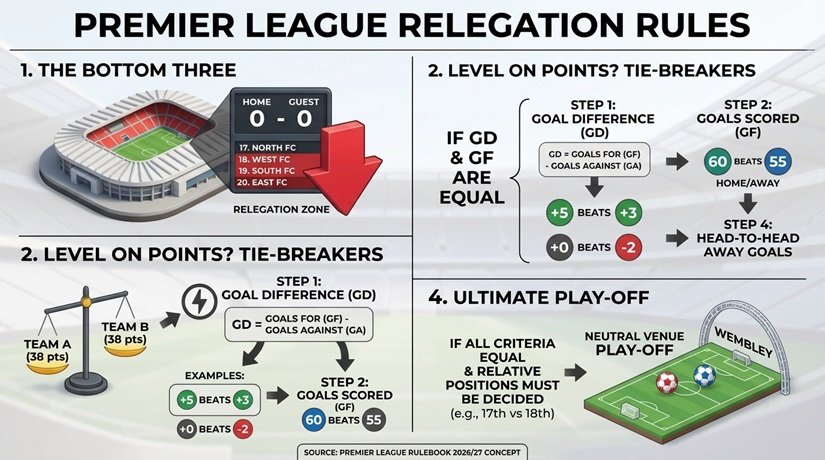
If two clubs finish level on points in the Premier League relegation battle, goal difference separates them first. If that’s also equal, the order is goals scored, head-to-head points, head-to-head away goals and, if survival still cannot be decided, a neutral-ground play-off.
The bottom three clubs go down, so these rules can decide which side finishes safely in 17th and which drops into the Championship in 18th. But equal points alone don’t trigger an extra match.
How Premier League relegation works
Each Premier League club plays 38 matches, facing every other club once at home and once away. A win earns three points, a draw earns one, and a defeat earns none.
After those matches, the teams finishing 18th, 19th and 20th are relegated to the Championship. Seventeenth is the lowest position that keeps a club in the Premier League.
Points come first. The tie-breakers only become relevant when clubs have the same total, so a better goal difference cannot put a team above an opponent with more points.
If you want the basics behind the table, our guide explains how football league points are calculated.
Premier League relegation rules: tie-breaker order
The tests work in a strict sequence. Once one separates the clubs, there’s no need to move to the next.
| Order after points | Tie-breaker | What decides it? |
|---|---|---|
| 1 | Goal difference | Goals scored minus goals conceded across the league season. |
| 2 | Goals scored | The club with more league goals finishes higher. |
| 3 | Head-to-head points | The club with more points from the matches between the tied teams finishes higher. |
| 4 | Head-to-head away goals | The club with more away goals in those meetings finishes higher. |
| 5 | Neutral-ground play-off | An extra match settles the order if the clubs remain inseparable and relegation depends on it. |
Goal difference comes before head-to-head results
Goal difference is the number of goals a team scores minus the number it concedes. For instance, 40 scored and 55 conceded gives a goal difference of −15.
This measures the whole league season, not just games against relegation rivals. So beating the club next to you in the table doesn’t automatically give you the advantage if you finish level on points. Goal difference must be checked first.
A famous demonstration came at the other end of the table in 2011/12. Manchester City and Manchester United both finished on 89 points, but City’s +64 goal difference beat United’s +56. City won the title.
That wasn’t a relegation battle, but it shows the same first tie-breaker at work: equal points don’t necessarily mean equal positions.
Goals scored comes next
If the clubs have identical points and goal difference, the team that has scored more league goals finishes higher. The head-to-head results still don’t come into it yet.
This is where the table’s goals-for column matters. Don’t confuse it with goal difference: one counts goals scored, while the other subtracts goals conceded from that total.
Then come points from their meetings
Only when points, goal difference and goals scored are all equal does the comparison narrow to the league matches between the tied clubs. The side that collected more points in those meetings finishes higher.
Arsenal and Manchester City’s 2025/26 meetings show how this calculation works. They drew 1–1 at Arsenal, and City won the return match 2–1, giving City four head-to-head points against Arsenal’s one.
That advantage would matter only if their overall points, goal difference and goals scored were equal. A win over your rival doesn’t let you skip the earlier tests.
Away goals are a separate, later test
If head-to-head points are also equal, the next comparison is away goals scored in the matches between the tied clubs. It isn’t a count of every away goal across the season.
And yes, away goals still appear here. UEFA removed its away-goals rule from club competitions from 2021/22, but the Premier League retains this specific head-to-head tie-breaker.
Would 17th and 18th have a relegation play-off?
Not simply because they finish on the same points. The normal tie-breakers decide their order first. A one-off match at a neutral ground is the final option if none of those tests separates them and their positions decide relegation.
There isn’t a routine play-off between the teams in 17th and 18th. Nor is Wembley a guaranteed venue for an exceptional decider: the Premier League Board determines the arrangements.
So if your club finishes level on points with a relegation rival, start with goal difference, not the possibility of another fixture. That’s the first comparison the rules require.
Does reaching 40 points guarantee survival?
No. Forty points is a familiar survival target, not an official safety line. Relegation depends on where a club finishes in the table, rather than whether it reaches a fixed total.
West Ham United went down with 42 points in 2002/03, the highest relegated total in the Premier League’s 20-team era. Nottingham Forest stayed up with 32 points in 2023/24.
Those two seasons show why a points target and a guarantee are different things. A club needs enough to finish above the bottom three, with the tie-breakers applied where necessary.
Other questions fans ask
Can a team be relegated before the final day?
Yes. A club is mathematically relegated once it can no longer finish 17th or higher, even if it still has matches left to play.
Does having more wins decide a points tie?
No. Number of wins isn’t a separate test in this sequence. After equal points, the first comparison is goal difference, followed by goals scored.
Does a better head-to-head record beat a better goal difference?
No. Goal difference takes priority. Head-to-head points are considered only after overall goal difference and goals scored have failed to separate the teams.
What happens to the relegated clubs?
They compete in the Championship the following season. The Premier League also makes parachute payments to help relegated clubs adjust financially after leaving the division.
For a close survival race, keep an eye on the goals columns as well as the points. Because goal difference comes first, a goal scored or conceded can affect the tie-breaker even when it doesn’t change the match result.

Bernard Bassey
Bernard Bassey runs SPBO Scores from Abuja and writes about football rules, records and Nigerian football.