How Are Football League Points Calculated? All you need to know
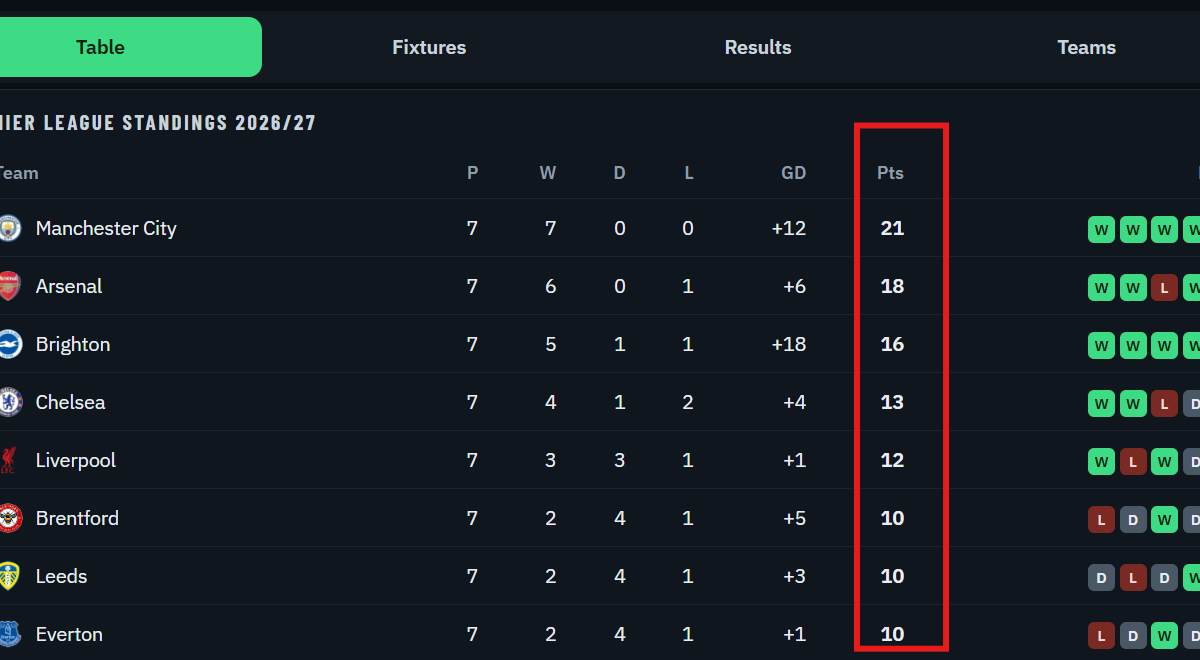
How are football league points calculated? Under the standard system, a team earns three points for a win, one point for a draw and no points for a defeat. Multiply its wins by three, then add its draws: points = (3 × wins) + draws. Losses contribute nothing to that total.
That calculation gives you the points earned from results. To understand the team’s position in a published table, you may also need to check tie-breakers and any official points adjustments. Here is how to work through both without confusing goals, points and league position.
Before you start, what you need know these:
Have the following information ready before calculating a team’s total:
- Its wins, draws and losses: these are the results used in the standard points formula in football.
- The competition you are counting: keep the results within the same league or table rather than mixing competitions.
- The relevant matchday or table update: a provisional table may not match another standings display.
- The competition’s rules: older tables and some grassroots competitions may use a different scoring system.
Practical tip: write down the team’s record before doing any arithmetic. Keeping wins, draws and losses in separate columns makes the calculation easier to check.
Step 1: Give each result its points value
The standard three-point system works as follows.
| Match result | Points earned by the team |
|---|---|
| Win | 3 |
| Draw | 1 |
| Loss | 0 |
For a drawn match, each team receives one point. For a match with a winner, the winning team receives three points and the losing team receives none. Do not divide the winner’s three points between the two sides.
The standard system rewards the result, not the number of goals scored. A bigger winning margin does not turn a single victory into extra league points, although goals can matter when teams need to be separated in the table.
Step 2: Multiply wins by three, then add draws
Use this formula for a competition operating the standard system: total points = (wins × 3) + (draws × 1) + (losses × 0). You can shorten it to (wins × 3) + draws because multiplying losses by zero adds nothing.
Worked example: 20 wins, eight draws and 10 losses
The table below shows a 38-match record contains 20 wins, eight draws and 10 defeats. Here is the calculation broken into parts.
| Result type | Number | Calculation | Points |
|---|---|---|---|
| Wins | 20 | 20 × 3 | 60 |
| Draws | 8 | 8 × 1 | 8 |
| Losses | 10 | 10 × 0 | 0 |
| Total | 38 matches | 60 + 8 + 0 | 68 |
The team therefore has 68 points from its results. The 10 defeats are part of its playing record, but they do not subtract points under the standard formula.
Step 3: Check that the results match games played
Your second check is games played = wins + draws + losses. In the example above, 20 + 8 + 10 equals 38, matching the stated number of matches.
Practical tip: if your result counts do not add up to the displayed games played, stop and check the record before comparing points. Recheck the competition, matchday and individual result totals rather than changing the points formula to force a match.
These are the main abbreviations you will encounter when reading a league table.
| Column | Meaning | How to use it |
|---|---|---|
| P | Games played | Check against wins + draws + losses |
| W | Wins | Multiply by three |
| D | Draws | Add one point for each |
| L | Losses | Add no points |
| GF | Goals for | The team’s goals scored |
| GA | Goals against | The team’s goals conceded |
| GD | Goal difference | Calculate GF minus GA |
| Pts | Total points | Compare with your points calculation |
Step 4: Understand why fewer defeats may not mean more points
Compare two records, a team with 20 wins, eight draws and 10 losses earns 68 points, while one with 18 wins, 12 draws and eight losses earns 66. Both have played 38 matches.
The second team has lost fewer games, but it still has fewer points. Its additional draws do not outweigh the first team’s additional wins. This is why checking only the losses column can give you the wrong impression of which side should be higher on points.
Practical tip: when comparing teams, calculate their points first. Use the win and draw totals to explain the difference, rather than assuming the team with fewer defeats must lead.
Step 5: Separate points from tie-breakers
Two teams can have the same points total without sharing the same position. Competitions use tie-breakers to put level teams in order; these do not change the basic three-points-for-a-win calculation.
Goal difference means goals scored minus goals conceded: GD = GF − GA. It is a separate measure from points, so you do not add goal difference to the points total.
The order of tie-breakers depends on the competition. Possible criteria include overall goal difference, goals scored, head-to-head results and disciplinary measures. Do not assume that the first tie-breaker in one league is also the first in another.
For example, the Premier League uses overall goal difference and then goals scored to separate teams level on points. Manchester City and Manchester United both finished the 2011–12 season with 89 points, but City’s goal difference of +64 was better than United’s +56. That separated them without changing either team’s points total.
Practical tip for Nigerian fans: when checking a Nigerian competition, consult that competition’s published rules rather than importing the Premier League’s tie-breaker order. The general points calculation and the rules for ranking level teams are two separate checks.
Step 6: Investigate a mismatch with the published table
If your arithmetic is correct but the displayed points differ, check for a provisional table, a points deduction or another off-field adjustment. These are possible reasons a broadcast graphic or published standing may not match a simple calculation from wins and draws.
- Confirm the scope: make sure all counted results belong to the same competition.
- Confirm the update: compare figures from the same matchday or standings feed.
- Check official adjustments: look for any sanction or other change affecting points.
- Confirm the scoring rules: historical two-points-for-a-win tables exist, and some grassroots leagues use additional scoring provisions.
A points deduction is different from a defeat: a defeat earns zero match points, while a deduction is an adjustment outside that basic result calculation.
Common mistakes to avoid
- Adding goals to points. Goals feed into goals scored and goal difference, not directly into the standard points formula.
- Subtracting points for every defeat. A standard loss earns zero; it does not automatically remove previously earned points.
- Giving a draw three points. Each team receives one point for a draw.
- Combining unrelated results. Keep your tally scoped to a single table when accuracy matters.
- Using one universal tie-breaker order. The order varies between competitions.
- Applying modern scoring to every historical table. Some older tables awarded two points for a win.
Quick summary: what to do next
Count the wins and draws, calculate (wins × 3) + draws, then check that wins, draws and losses add up to games played. If teams are level, use the competition’s tie-breakers; if your total differs from the published table, check its update and any official adjustments. That keeps the points calculation separate from the rules that determine final position.

Bernard Bassey
Bernard Bassey runs SPBO Scores from Abuja and writes about football rules, records and Nigerian football.


1 comment