Half Spaces in Football: Meaning, Uses and Player Examples
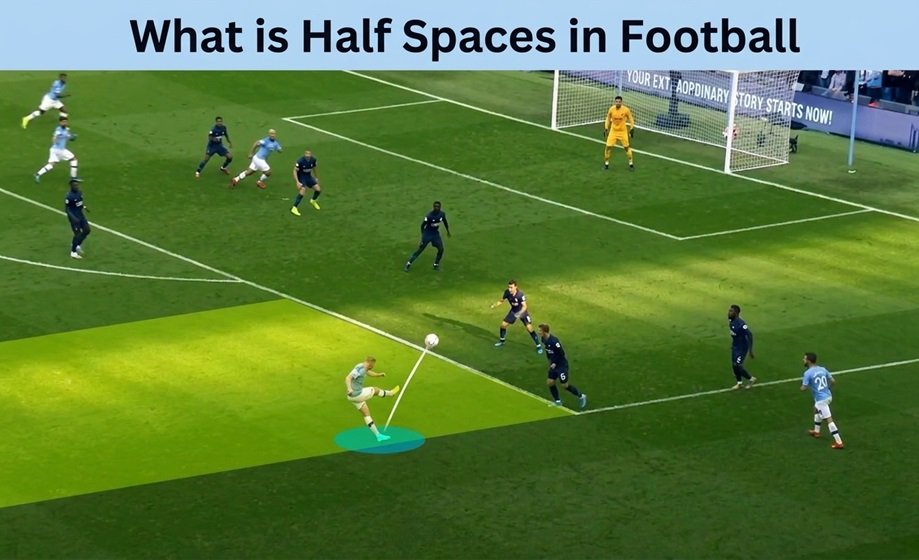
Half spaces in football are the two lengthways channels between the centre of the pitch and the wide areas. Think of them as the inside-left and inside-right lanes. They give attackers room to receive, pass or shoot without being as wide as a winger on the touchline.
If you’ve watched David Silva create chances from the inside-left channel or Lionel Messi move in from the right at Barcelona, you’ve seen these spaces being used. The interesting part isn’t just where those players receive the ball. It’s the choices their position creates for teammates and defenders.
Where exactly are the half spaces?
Imagine dividing the pitch into five lanes running from one end to the other. From left to right, the arrangement looks like this:
| Lane | Area | Where to picture it |
|---|---|---|
| 1 | Left wide area | Nearest the left touchline |
| 2 | Left half-space | Between the left wide area and the centre |
| 3 | Central lane | Through the middle of the pitch |
| 4 | Right half-space | Between the centre and the right wide area |
| 5 | Right wide area | Nearest the right touchline |
These channels run the length of the pitch, not just around the penalty area. But teams particularly want to receive in them in the final third, often near the edge of the box, where they can threaten goal.
You’ll also hear them called inside channels. The term half-space comes from the German word halbraum, and the idea is associated with German coaching terminology.
Why do teams attack through half spaces?
The attraction is simple: the centre can be crowded, while the touchline leaves an attacker farther from goal. A half-space offers a useful balance, with access towards goal and passing options on either side.
More than one passing option
A player receiving in an advanced half-space can find a striker centrally, release an overlapping teammate outside or pass behind the defence. They can also move the ball backwards to keep possession. That variety makes the next action less predictable.
So receiving there doesn’t mean a player must turn and shoot. Sometimes the dangerous action is a pass outside, allowing another player to cross. Sometimes it’s a diagonal ball through the back line.
An awkward decision for defenders
Half-space attackers can sit in an area between the responsibilities of central and wide defenders. That can leave opponents deciding who should follow the player and who should hold their position.
Width helps create that problem. A winger staying outside can draw the full-back away, while a centre-forward occupies the nearest centre-back. The gap between those defenders can then become available to a midfielder.
Different angles for shots and crosses
A player’s stronger foot changes what they can do from the same channel. A right-footed attacker in the left half-space can move onto that foot to shoot. A right-footed creator in the right half-space can instead deliver a dangerous cross towards the forwards.
That’s why two players can occupy similar areas but offer different threats. The space gives them options; their strengths influence which option they choose.
How do teams get a player into the half-space?
It usually involves more than one player moving into a gap. Teammates help create the room and the passing route.
- A winger holds the width – This can draw the full-back outside and leave room for a midfielder inside.
- A striker occupies the centre-back – Keeping that defender busy can prevent them stepping forward to pressure the receiver.
- A winger moves infield – A full-back or midfielder can then provide width with an overlapping run outside.
- A runner goes behind the defence – That movement can push defenders deeper and create more room for someone receiving in front of them.
- A full-back moves inside – This can add another player to the half-space during the build-up.
The pass matters too. Coaches’ Voice explains that a player can face towards the touchline, then disguise a pass back inside. That can make the attack less predictable and give the receiver more time for their first touch.
In our view, this is the most useful way to understand half-space play: don’t watch only the player receiving. Watch the teammate whose movement made that reception possible.
Players who show what half-space play looks like
David Silva: receiving and creating on the left
David Silva regularly occupied the left half-space for Manchester City and Spain. Earlier at City, he could start wide and move inside. Under Pep Guardiola, he also advanced from a left-sided number-eight role in a 4-3-3.
From there, Silva could receive between the opposition’s lines, pass behind the defence or carry the ball forward before crossing or cutting it back. His example shows that a half-space is a place to create from, not simply a channel to run through.
Lionel Messi: coming inside from the right
At Barcelona, Messi attacked from the right wing and moved inside to combine, dribble and shoot. He also used the right half-space to pass behind the defence, including towards runners arriving from the left.
Later, he more often moved into that area before receiving. He could then turn towards the centre-backs and look for a left-footed shot. The threat came from both his passing and his ability to carry the ball towards goal.
Kevin De Bruyne: crossing from an inside position
Kevin De Bruyne offers another version. FourFourTwo highlights his crossing from the half-space, where he can find forwards attacking behind the defence without delivering from the touchline.
This is a useful contrast with Messi. Both exploit an inside channel, but the action that follows can be very different: a cross, a dribble, a combination or a shot.
Salah and Mané: wide players moving inside
Mohamed Salah and Sadio Mané are also examples of wingers who use half spaces by cutting inside. The role isn’t reserved for midfield playmakers; an attacker starting wide can arrive in the same channel.
Is a half-space the same as being between the lines?
No. They describe different aspects of a player’s position. A half-space identifies the lengthways lane they occupy. Being between the lines describes their position between opposition units, such as midfield and defence. A player can therefore receive in a half-space and between the lines at the same time.
Silva is a good example of that combination. But a full-back moving inside during deeper build-up can also occupy a half-space without being in the same advanced position.
Does a player have to be a number eight?
No. Number eights often use these channels, but attacking midfielders, wingers, forwards and full-backs can operate there too. Even centre-backs can carry the ball into them as they advance into midfield.
A forward dropping deeper can also receive in a half-space. Harry Kane, Roberto Firmino and Karim Benzema are examples identified by Coaches’ Voice. For the related attacking role, see how a false 9 works.
The useful distinction is this: half-space describes an area, not a fixed player position. Who occupies it can change as teammates move and exchange places.
What should you watch during a match?
When an attacker receives inside the wing but outside the centre, look at the nearest winger, striker and defenders. Has the winger drawn the full-back wide? Is the striker keeping a centre-back occupied? Those movements help explain why the receiver has room.
Then watch the next decision. A pass outside, a ball behind the defence and a turn towards goal can all start from the same channel. That range of choices is what makes half spaces useful, not the name itself.

Bernard Bassey
Bernard Bassey runs SPBO Scores from Abuja and writes about football rules, records and Nigerian football.