Football Shirt Numbers: Meaning by Position, From 1 to 11
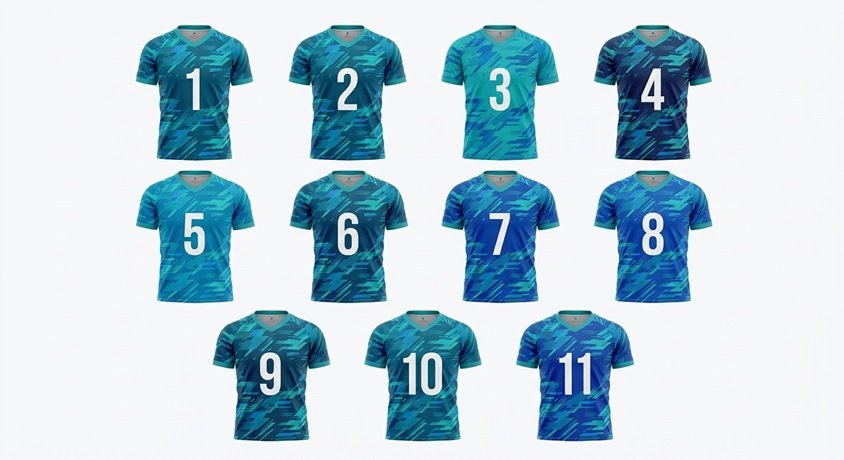
Football shirt numbers traditionally describe positions: 1 means goalkeeper, 9 means centre-forward, and 10 usually means a creative attacking player. But modern squad numbers don’t always match those roles, so the number on a player’s back is a clue, not a fixed positional rule.
That’s why a team can need a “number 9” even when someone already wears that shirt. The phrase describes the main striker’s role, not necessarily the number printed on the kit. Once you separate the shirt from the job, football’s numbering language becomes much easier to follow.
Football shirt numbers and their traditional positions
The table below gives a common interpretation of numbers 1 to 11. Treat it as a starting point rather than a universal system: numbers 4, 5 and 6 have different positional associations across football traditions.
| Shirt number | Traditional position or role | What it usually tells you |
|---|---|---|
| 1 | Goalkeeper | The number most firmly associated with the goalkeeper. |
| 2 | Right-back | The defender on the right side of the back line. |
| 3 | Left-back | The defender on the left side of the back line. |
| 4 | Centre-back or defensive midfielder | A central defensive role, with the exact position depending on the numbering tradition. |
| 5 | Centre-back | Usually a central defender, though some South American traditions associate it with defensive midfield. |
| 6 | Defensive midfielder or centre-back | Often the holding midfielder in tactical discussion; also a traditional defensive shirt. |
| 7 | Right midfielder or right winger | A wide player, commonly associated with attacking skill and goals. |
| 8 | Central midfielder | A midfielder who connects defence and attack. |
| 9 | Centre-forward | The main striker. |
| 10 | Attacking midfielder or second striker | A creative player operating behind or around the main striker. |
| 11 | Left midfielder or left winger | A wide player on the left. |
Why did football use numbers 1 to 11?
Shirt numbers helped people identify players, and they became closely linked to positions. In the traditional system, the starting eleven wore numbers 1 to 11, beginning with the goalkeeper and moving through the team. Within each line, numbering generally ran from right to left.
The old 2-3-5 formation helps explain the pattern. It had two defenders, three half-backs and five forwards. The right winger wore 7, the centre-forward wore 9, and the left winger wore 11. Numbers 8 and 10 belonged to the inside forwards, either side of the centre-forward.
But formations changed. Some players moved deeper while keeping their numbers, which helps explain why central defenders became associated with shirts such as number 5. The numbering developed alongside tactics rather than being completely reset whenever a new formation appeared.
What do a number 6, 8 and 10 actually do?
These three numbers are especially useful because they describe different midfield jobs. A player doesn’t need to wear the matching shirt to perform the role.
The number 6 often known as the holding midfielder
A number 6 commonly means the defensive or holding midfielder: the player working deeper in midfield, behind the more attacking midfielders. But the term isn’t identical everywhere. In English football, 6 can also refer to a centre-back.
So if someone says a team needs a better number 6, the surrounding conversation matters. Are they discussing a holding midfielder or a central defender? Both uses exist.
The number 8, the link between defence and attack
A number 8 usually means a central, box-to-box midfielder. “Box-to-box” describes a player working between defence and attack rather than staying in just one area of midfield. The role links those parts of the team and often involves covering plenty of ground.
The number 10, known as the creative player
A number 10 is usually the attacking midfielder or second striker who creates chances behind the main forward. You may hear that player described as operating “between the lines”, meaning in the space between the opposition’s midfield and defence.
The distinction is useful: 6 suggests the deeper midfield role, 8 connects defence and attack, and 10 supplies creativity further forward. Those are descriptions of jobs, not compulsory shirt choices.
What makes number 9 different from number 10?
The simplest distinction is that the number 9 is the main centre-forward, while the number 10 is the creative player behind or around that forward. Both can be attacking players, but the terms describe different roles.
So when a supporter says, “We need a proper number 9,” they usually mean a main striker. They aren’t asking the club to give an existing player a different shirt. Equally, calling someone a number 10 describes their creative attacking role, even if their actual squad number is something else.
How numbers fit different formations
The same traditional numbers can carry into different team shapes, but the players’ positions shift. In a 4-3-3, numbers 7 and 11 are associated with wingers playing higher up the pitch, while the number 8 works within a three-player midfield.
In a 4-2-3-1, the number 10 sits behind a single number 9, with two holding midfielders further back. That makes the distinction between the creative midfielder and the main striker particularly clear.
There isn’t one universal numbered formation, though. A traditional England 4-4-2 arrangement has used 2, 5, 6 and 3 across defence, with 7, 4, 8 and 11 across midfield. That puts 4 in midfield and 6 in defence, unlike another common interpretation of those numbers.
Why modern shirt numbers don’t always match positions
Squad numbers weakened the old connection between a shirt and a starting position. They became widely used in the 1990s, with players keeping their assigned numbers rather than the starting eleven always wearing 1 to 11. Higher numbers consequently became normal.
Personal preference matters too. Players may choose favourite numbers or alternatives because their preferred number is already taken. There is no universal rule that every striker must wear 9 or every creative midfielder must wear 10.
Ivan Zamorano offers a memorable example. At Inter Milan, he wore 18 with a plus sign between the digits after Ronaldo took number 9: 1 + 8 still made 9. It was a personal way of preserving his connection with the striker’s number.
Other shirts become strongly associated with particular players. Pelé and Diego Maradona both wore number 10, helping connect that number with celebrated creative attackers. But a famous association still isn’t a rule about who can wear it.
Common questions about football shirt numbers
Does number 7 always mean a right winger?
No. Right midfield and right wing are its traditional associations, but modern squad numbers don’t dictate where a player must play. The shirt alone doesn’t establish their position.
Does number 1 mean goalkeeper?
Number 1 has the strongest continuing association with a single position: goalkeeper. It’s frequently used by the starting goalkeeper, but that doesn’t make every other number a reliable guide to an outfield position.
Why is number 5 a midfielder in some teams?
Different football traditions developed different numbering conventions. In some South American countries, 5 is associated with the defensive midfielder rather than a centre-back. These differences reflect historical formations and have survived later tactical changes.
Can you tell a player’s position from a high squad number?
Not reliably. A player wearing 27, for instance, could play anywhere on the pitch. High squad numbers don’t have the same established positional meanings as the traditional 1-to-11 system.
Finally, the most useful distinction is between the number a player wears and the role they perform. When the conversation turns to a number 6, 8, 9 or 10, think about the job being described before looking at the shirt.

Bernard Bassey
Bernard Bassey runs SPBO Scores from Abuja and writes about football rules, records and Nigerian football.


2 comments