Why Do Footballers Cut Holes in Their Socks?
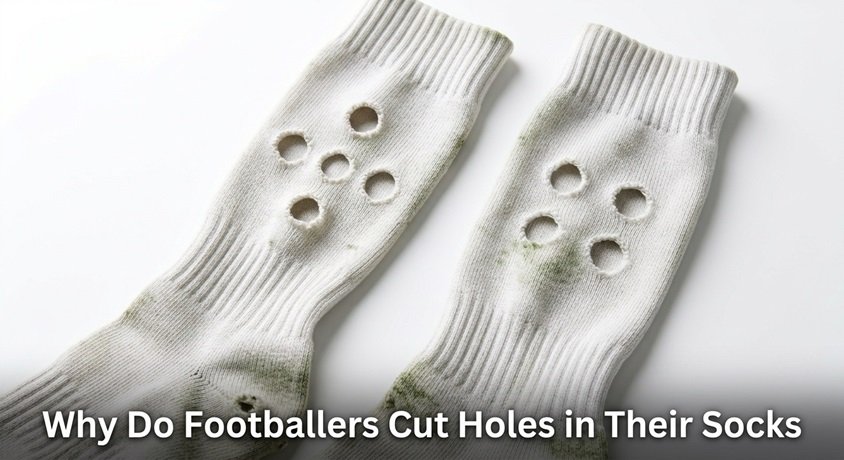
Footballers cut holes in their socks mainly to reduce tightness around their calf muscles. The cuts release tension in the material, helping the socks feel less restrictive during a match. It’s primarily a comfort adjustment, rather than a fashion statement.
That’s why players such as Kyle Walker, Bukayo Saka and Jude Bellingham have appeared in socks that look deliberately torn. But feeling more comfortable and gaining a proven performance advantage are two different things.
Why are football socks so tight?
Football socks have a close, stretchy fit that can help keep slip-in shin pads in position. The drawback is that the same material can feel restrictive around some players’ calves.
It isn’t that every football sock is uncomfortable. A fit that suits one player may feel too tight on another, particularly around muscular calves. Cutting the material is a way to ease that pressure while still wearing the long sock.
Think of it as a local adjustment to the kit. The complaint is about tightness in a particular area, not necessarily the fit of the entire sock.
Why do players cut the back of their socks?
The back of the sock covers the calf, which is where players commonly want to relieve pressure. The cuts vary: you might see one large opening, two round holes or several smaller holes running up the leg.
The intended effect is the same. Cutting through the tight material releases some of its tension, giving the player a less restricted feeling while running and moving.
There isn’t one standard arrangement. In our view, those different patterns make more sense as personal fit adjustments than as a technique everyone needs to copy.
Kyle Walker’s explanation makes it simple
Walker has explained that his socks were too tight and were putting pressure on his calves. Recounting his comments to SPORTbible in 2021, Stand Out Socks reports that he cut holes to release the tension, then kept doing it after a few good games.
That account helps explain both the original decision and why the habit stuck. The first concern was physical discomfort. After the change felt right and his matches went well, he continued with it.
But good performances afterwards don’t establish that the holes caused them. Walker’s explanation is useful as an account of comfort and personal preference, not proof that cutting socks makes a player better.
Which other footballers wear socks with holes?
Walker isn’t alone. SPBO has named several other players who have been pictured wearing cut-up socks:
- Bukayo Saka
- Jude Bellingham
- Conor Gallagher
- Gareth Bale
- Neymar
Bellingham’s case has attracted particular attention. According to AS, as reported by JobsFootball in Football, his complaint concerns socks that don’t suit footballers’ muscular legs and put excessive pressure on them.
The practice has also spread into lower divisions and amateur football. Jobs in Football describes players copying the habits of their footballing heroes. So there can be more than one reason behind the look, a player may be addressing discomfort or following a familiar football trend. You can’t tell which simply by counting the holes.
Do the holes improve circulation or prevent cramps?
Better circulation, reduced muscle tension and fewer cramps are among the benefits claimed for cutting socks. Stand Out Socks connects these claims to easing pressure around the calves.
Those claims need more caution than the straightforward comfort explanation. Jobs in Football questions whether the practice is effective and describes it as a search for small improvements in performance.
A player saying their socks feel better isn’t the same as demonstrating improved blood flow or fewer cramps. Likewise, seeing a player perform well in cut socks doesn’t show what caused that performance.
Conor Gallagher, for instance, wore socks with two circular holes during Chelsea’s 3-2 win over Luton. Stand Out Socks presents his performance as a positive example of the adjustment. But the match result alone can’t establish that his socks made a difference.
In our view, comfort is the clearest explanation for the habit. Treating cut socks as a reliable way to prevent cramps or improve performance goes further than these player accounts can establish.
Is this the same as wearing grip socks?
No. The two adjustments address different areas. Holes around the calf are intended to relieve pressure from the upper part of the sock. Grip socks have extra grip underneath the foot.
So, if you’re looking at a close-up during a match, don’t confuse a calf opening with the grip beneath a player’s foot. One concerns tightness around the leg; the other concerns grip.
Are footballers allowed to play with torn socks?
The visible practice and its treatment under kit regulations aren’t quite the same thing. Jobs in Football reports that authorities have generally tolerated these holes, while also describing restrictions on torn kit and concerns about LaLiga’s dress requirements.
That calls for a qualified answer, not a blanket yes. The reported examples show tolerance of the practice, rather than establishing that every sock alteration is permitted in every competition.
Should you cut your own football socks?
We wouldn’t copy the look simply because a favourite player does it. If your socks already feel comfortable, the main reason players give for cutting them doesn’t apply to you.
There’s also a trade-off. Cutting holes weakens the fabric and can make socks wear out sooner. Grip Active also warns that poorly placed cuts can create discomfort.
For your own matches, we’d put fit first. Football socks should feel snug rather than excessively tight. A hole pattern isn’t something you need to copy; the useful goal is a fit that lets you concentrate on the game.

Bernard Bassey
Bernard Bassey runs SPBO Scores from Abuja and writes about football rules, records and Nigerian football.