American Football Positions and Their Roles: A Step-by-Step Guide
To understand football positions and their roles, start by identifying which team has the ball, then follow the jobs around it. This guide covers American football, the sport discussed in the available references – not association football. American football separates players into three specialist units: offence, defence and special teams. Understanding those units gives you a framework for recognising individual positions.
Before you start: what you need
For this walkthrough, use a match recording you can pause, or make notes while watching a game. The suggested method is to study one group at a time rather than trying to identify every player immediately.
First, learn two reference points. Each team is allowed 11 players on the field at once. The line of scrimmage is the starting reference for a play, where the ball is snapped to begin the action.
Scope note: the available material supports the attacking and defensive positions explained below. It identifies special teams as the kicking unit, but does not provide enough detail for a complete position-by-position explanation of that unit.
Step 1: identify the unit before the player
Before looking for a quarterback or receiver, ask what the team is trying to do. The three units have different purposes.
| Unit | Main purpose | Your first viewing question |
|---|---|---|
| Offence | Possess the ball and advance towards the opposition’s end zone to score. | Who receives the ball, and who helps move it? |
| Defence | Prevent scoring and try to take possession from the opposition. | Who attacks the ball carrier, and who guards receivers? |
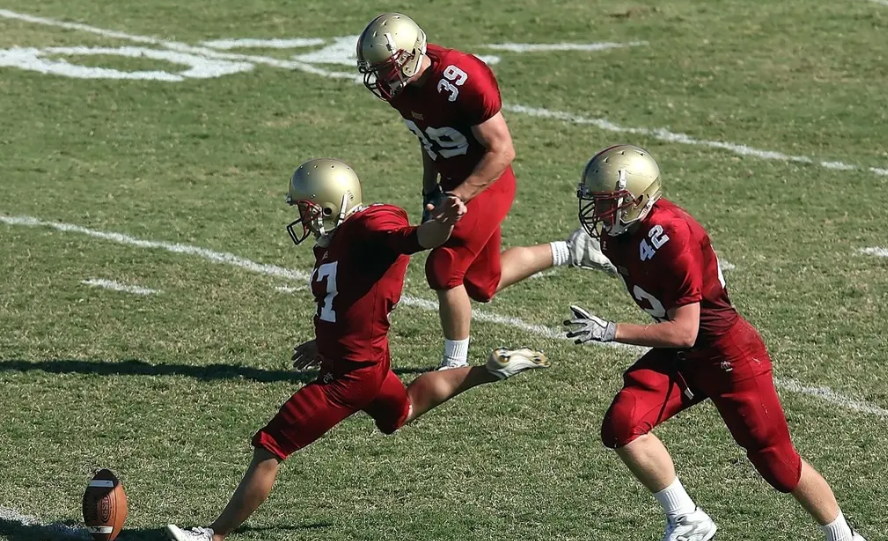
| Special teams | Handle kicking situations. | Is this a kicking play rather than a regular attacking play? |
My suggested viewing method is to name the unit first and the individual position second. That makes the task more manageable: you are identifying a job within a group, not memorising a list without context.
Step 2: find the centre and follow the quarterback
The centre (C) begins a play from scrimmage by snapping the ball to the quarterback (QB). The quarterback directs the offence and can pass, hand the ball to a running back or run with it.
On your first viewing, follow only that exchange. On a replay, ask which decision the quarterback made:
- Handoff: the quarterback gives the ball to a running back.
- Pass: the quarterback throws to a receiver.
- Run: the quarterback carries the ball himself.
The useful distinction is that the centre starts the exchange, while the quarterback determines what happens next with the ball. Both also have responsibilities beyond that moment: the centre helps protect the quarterback, and the quarterback calls plays and signals.
Step 3: recognise the offensive line
The offensive line consists of five players: a centre, two guards and two tackles. Their main work is blocking, protecting the quarterback and creating running lanes for ball carriers.
| Position | Where to look | Main role |
|---|---|---|
| Centre – C | Usually in the middle of the line. | Snaps the ball and helps protect the quarterback. |
| Left and right guard – LG, RG | Between the centre and the tackles. | Block for the quarterback and ball carriers. |
| Left and right tackle – LT, RT | At the outer ends of the offensive line. | Contribute to pass protection and opening running lanes. |
Practical exercise: replay a running play without following the ball. Instead, watch the blockers and look for the space they try to create. Then replay a passing play and focus on their attempts to keep defenders away from the quarterback. Those are the line’s two central responsibilities.
Do not assume every attacking player is a potential pass catcher. Interior offensive linemen are normally ineligible to catch forward passes.
Step 4: separate runners, receivers and hybrid roles
Once you can recognise the line and quarterback, move to the players whose roles involve carrying the ball, catching it or supporting those actions. Their responsibilities can overlap.
Running back: carrying the ball, with additional duties
A running back (RB) primarily carries the ball on running plays, but can also catch passes. Blocking is another relevant part of the position’s skill set.
Suggested exercise: after identifying a handoff, follow the runner. On the next play, check whether the running back receives the ball again or contributes without carrying it. This helps you avoid treating the position as a single-action job.
Fullback: blocking and short-yardage running
A fullback (FB) blocks for the running back and helps protect the quarterback on passing plays. Fullbacks can also carry the ball in short-yardage situations.
The key distinction is emphasis: the running back is primarily a ball carrier, while the fullback’s responsibilities place greater emphasis on blocking and short-yardage work.
Wide receiver: routes and catches
A wide receiver (WR) runs routes and attempts to catch passes from the quarterback. Speed, agility, catching ability and evading defenders are important skills for the role.
Suggested exercise: watch a receiver from the start of a play rather than waiting for the pass. Look at the movement before the catch attempt, not just the final result.
Tight end: receiving and blocking
A tight end (TE) combines receiving and blocking duties and lines up beside an offensive tackle, on either side of the quarterback.
To distinguish the role, look for both kinds of contribution: a tight end can help a teammate through blocking or become a receiving option. Watching only the eventual ball carrier misses part of that job.
Step 5: read the defence from the line backwards
The defence tries to prevent scoring through actions such as tackling attacking players, intercepting passes and stopping the offence from advancing into a scoring position.
Defensive tackles and defensive ends
Defensive tackles (DT) work inside the defensive line. Their duties include stopping running plays and getting through gaps to pressure the quarterback or disrupt the attacking backfield.
Defensive ends (DE) occupy the ends of the defensive line and are often tasked with pressuring the quarterback.
Suggested exercise: first identify whether a defender starts inside or at the edge of the line. Then watch whether he is trying to stop a run or reach the quarterback. Use both starting position and action rather than judging from the final tackle alone.
Cornerbacks and safeties
Defensive back (DB) is a group label covering cornerbacks and safeties. These players cover receivers and defend against passes.
- Cornerback (CB): specialises in covering wide receivers and following their routes to prevent completed passes.
- Free safety (FS): covers deeper areas of the field.
- Strong safety (SS): often plays closer to the line to help defend against running plays.
My suggested comparison is to watch a cornerback alongside a safety on a replay. Ask whether the player is following a receiver or protecting an area deeper downfield. Treat this as a learning prompt, not a complete rule for every defensive arrangement.
Step 6: use formations as a guide, not a complete answer
A 4–3 defence describes an arrangement with four defensive linemen and three linebackers. Teams can use different arrangements according to their plans and game situations.
The available extracts identify linebackers within that formation but do not explain their individual responsibilities in sufficient detail. This guide therefore does not assign them duties unsupported by the references.
Suggested exercise: count the players in the defensive line before the snap, then compare their starting positions with what they actually do. This keeps formation recognition separate from understanding a player’s task.
Common mistakes to avoid
- Watching only the ball. Blockers protect the quarterback and create running lanes, so their contribution may happen away from the ball carrier.
- Thinking the quarterback must throw. A handoff or a quarterback run is also possible.
- Treating every receiver as a wide receiver. Tight ends have receiving duties, and running backs can catch passes too.
- Confusing offensive and defensive tackles. Offensive tackles belong to the blocking line; defensive tackles work inside the defensive line to disrupt the attack.
- Assuming every team uses one fixed arrangement. Positions can be arranged differently to suit game plans.
Your next steps
For your next viewing session, use this sequence: identify the unit, find the centre and quarterback, watch the offensive line, then study one runner or receiver. On defence, begin with the line before moving to cornerbacks and safeties.
The aim is not to name everyone immediately. My recommendation is to explain one player’s contribution on each replay: who started the play, who protected, who carried or caught the ball, and who tried to stop the attack. Build from those observations before tackling more detailed positional assignments.

admin
Writes about football for this site.